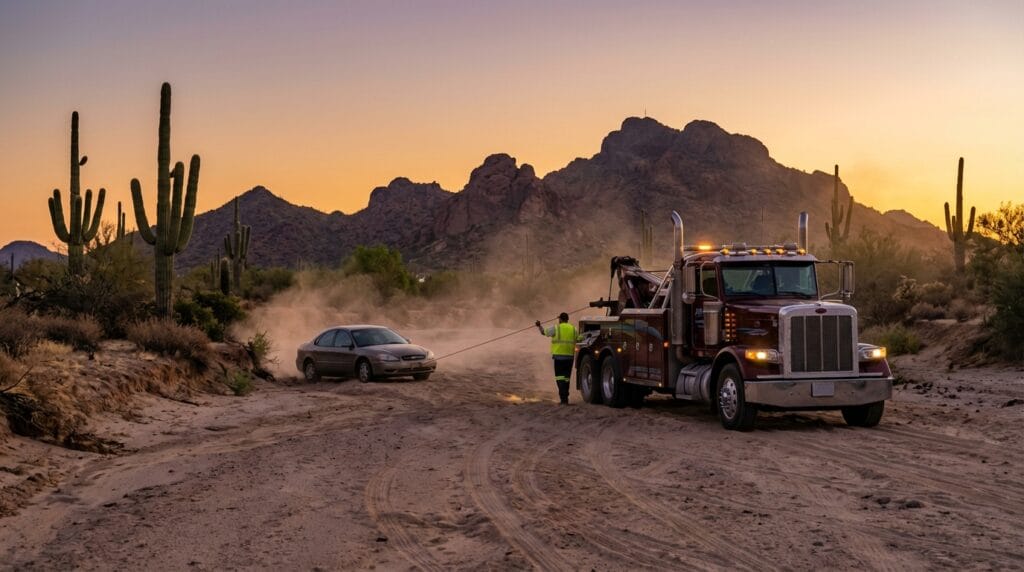
When your vehicle creates a suction bond with Mesa’s notorious clay or loose sand, standard towing methods immediately become obsolete. We deploy specialized winch out service protocols designed to overcome the immense static friction of off-road entrapment without severing your chassis.
Table of Contents
Defining the Winch Out Recovery Mechanism
A winch out is not a tow; it is a recovery operation. Towing implies a rolling vehicle on a paved surface, whereas a winch out addresses a vehicle that has lost traction and mobility due to environmental factors. In Mesa, this typically occurs in three specific environments: the silty beds of the Salt River (often accessed via the Bush Highway), soft shoulders along the Loop 202 post-monsoon, or unpaved construction zones where rapid development meets desert dust.
The core of this service involves a motorized spool (winch) mounted to a heavy-duty wrecker, utilizing a high-tensile steel cable or synthetic rope. The objective is to apply linear force to extract the vehicle from a “mire.” Miring refers to the depth at which the vehicle is stuck—wheel deep, fender deep, or cabin deep.
We distinguish this from “snatch” recovery. A winch applies constant, controlled tension. This is critical for modern vehicles with unibody constructions (common in sedans and crossovers like the Toyota RAV4 or Honda CR-V), where sudden jerking motions—typical of an amateur trying to pull you out with a strap—can warp the frame or rip off plastic bumpers. Our operators calculate the “Line Pull” required based on the vehicle’s Gross Vehicle Weight Rating (GVWR) and the resistance factor of the terrain.
The Physics of Resistance: Why You Are Stuck
Most drivers underestimate the force required to move a stuck vehicle. It is not a 1:1 ratio. If your 5,000-lb truck is stuck in mud, it does not take 5,000 lbs of force to move it. It often takes double or triple that amount. This is due to Mire Resistance.
When a vehicle sinks, the ground pushes back against the tires and undercarriage. This resistance creates a vacuum effect, especially in the wet clay found in certain Mesa pockets during January rains.
The Recovery Resistance Formula: Total Resistance = Rolling Resistance + Gradient Resistance + Mire Resistance + Damage Resistance.
We use the following resistance multipliers to determine the necessary equipment:
| Entrapment Depth | Resistance Factor | Multiplier Description |
|---|---|---|
| Wheel Depth | 100% of GVWR | The vehicle is stuck up to the bottom of the wheel rim. A 4,000 lb car requires 4,000 lbs of pull. |
| Fender Depth | 200% of GVWR | Mud covers the tires completely. A 4,000 lb car requires 8,000 lbs of pull. |
| Cab Depth | 300% of GVWR | Mud reaches the door handles. A 4,000 lb car requires 12,000 lbs of pull. |
Surface Drag Data (Static Friction Coefficients):
- Asphalt: Low resistance (rolling).
- Loose Sand (Mesa Desert): High resistance. Sand displaces under load, requiring continuous force to prevent re-sinking.
- Wet Clay/Mud: Extreme resistance. Creates suction.
- Gravel: Variable resistance.
If you attempt to pull a fender-deep truck (6,000 lbs) using a standard pickup with a chain, you are trying to move a load equivalent to 12,000 lbs. Your transmission will overheat, or the chain will snap before the stuck vehicle moves [1].
Methodology: The Professional Recovery Process
Our approach mitigates damage through a calculated four-step sequence. We do not just “hook and book.”
- Assessment and Stabilization
Before unspooling cable, we analyze the mire. Is the vehicle resting on its differential? If the undercarriage is grounded (high-centered), the resistance increases drastically. We may need to dig out the wheels or use air bags to lift the chassis slightly, breaking the suction seal before winching begins.
- Rigging the Anchor
The recovery vehicle (our wrecker) must have substantially more traction than the stuck vehicle. We position our truck on solid ground, often engaging “spades” (hydraulic legs that dig into the pavement or dirt) to anchor our unit. Without this, the winch would simply pull our truck into the mud toward you.
- Mechanical Advantage Calculation
For deep extraction, a single line pull is often insufficient or unsafe. We utilize snatch blocks (heavy-duty pulleys). By running the cable from our truck, to a block on your vehicle, and back to an anchor point on our truck, we effectively double the pulling power of the winch (2:1 mechanical advantage). This reduces stress on the winch motor and allows for smoother extraction.
- Controlled Tensioning
The operator engages the winch slowly. We monitor the cable for fraying or tension spikes. The driver of the stuck vehicle (or a second operator) steers to align wheels with the pull direction, minimizing drag. Once the vehicle reaches firm ground, we transition to vehicle towing or inspect it for immediate drivability.
The Dangers of DIY: Kinetic Energy Myths
A pervasive myth in Arizona off-roading culture is the “running start” recovery. This involves a friend connecting a strap to the stuck vehicle and accelerating hard to “yank” it out.
Why this fails:
- Shock Load: This generates massive kinetic energy spikes. Standard tow straps or chains are not elastic. They do not stretch; they snap. A snapped steel chain under tension becomes a projectile moving at hundreds of feet per second.
- Frame Damage: Modern crumple zones are designed to absorb impact, not withstand outward tension. A violent yank can alter suspension geometry, causing permanent alignment issues or frame twisting.
- Bumper Separation: Most tow hooks on stock SUVs are for “tie-down” during shipping, not recovery. They are often bolted to cosmetic structures, not the frame rails.
Professional winching uses static force. We remove slack slowly. If we use a kinetic rope (bubba rope), it is a calculated decision based on weight ratios, not a frantic attempt to jerk a vehicle free [2].
Nuance: When a Winch Isn’t Enough
While winching solves 90% of off-road entrapments, specific scenarios in Mesa require complex interventions.
The Rotator Requirement If a vehicle has rolled over into a culvert off US 60 or slid down a steep embankment near the Superstition Mountains, a standard flatbed winch is insufficient. The angle of the pull matters. Pulling horizontally on a vehicle located vertically below the road will drive the tires into the embankment wall. In these cases, we deploy a rotator or a boom lift to provide vertical lift before horizontal pull.
EV Weight Disparities Electric Vehicles (EVs) present a new variable in 2026. An electric truck like the Rivian R1T or Ford F-150 Lightning weighs significantly more than its combustion counterparts—often 7,000+ lbs due to the battery pack. A standard light-duty wrecker rigged for a Honda Civic cannot safely winch a bogged-down EV. The resistance loads (refer to the table above) can exceed 20,000 lbs. We dispatch heavy-duty units specifically for EV recovery to prevent equipment failure.
2026 Outlook: Technological Shifts in Recovery
The towing industry is moving toward smarter, safer recovery tech.
- Synthetic Rope Standardization: We are phasing out steel cables for synthetic fibers (Dyneema or similar). These ropes are stronger than steel by weight and, crucially, do not store as much kinetic energy. If they break, they drop dead rather than whipping back, significantly increasing bystander safety.
- Tension Monitoring Systems: New winch drums come equipped with load cells that transmit real-time tension data to the operator’s handheld remote. This eliminates the guesswork. If the tension approaches the Working Load Limit (WLL) of the rigging, the system alerts us to re-rig with more snatch blocks.
- GPS-Pinpoint Dispatch: January 2026 brings updated dispatch software. When you call us from a wash or trail, we don’t need cross streets. We use direct coordinate integration to locate you even in unmarked desert terrain.
Risk Management and Cost Factors
Pricing for winch out services is dynamic. Unlike a flat-rate tow, recovery is billed based on time and difficulty.
- Time on Scene: Digging out a differential takes manual labor.
- Rigging Complexity: Using three snatch blocks takes longer to set up than a straight line pull.
- Hazard Pay: Working on the shoulder of a high-speed freeway or in a precarious wash carries higher insurance risks.
Ignoring the problem is expensive. Leaving a vehicle in a wash overnight during Mesa’s rainy season risks total loss if a flash flood occurs. The cost of a professional winch out is a fraction of the cost of a flooded engine or a twisted frame.
Recover Your Asset Safely
Getting stuck is a physics problem, not a test of horsepower. The friction of Mesa’s mud and sand is unforgiving. Attempting to force your vehicle out often results in deeper entrapment or catastrophic mechanical failure.
We operate with the precise equipment needed to counteract mire resistance and restore mobility. Whether you are a contractor stuck on a job site or an off-road enthusiast caught in a wash, we have the rigging and the reach.
Don’t spin your wheels. For immediate extraction in Mesa, AZ: 480-725-5862 Request Assistance Online
Sources
- <a href="https://ops.fhwa.dot.gov/etotimpse/preparedness/tim/index.htm”>Federal Highway Administration – Traffic Incident Management & Towing
- Occupational Safety and Health Administration (OSHA) – Winching Safety Standards
- Arizona Department of Transportation – Monsoon Safety & Road Closures