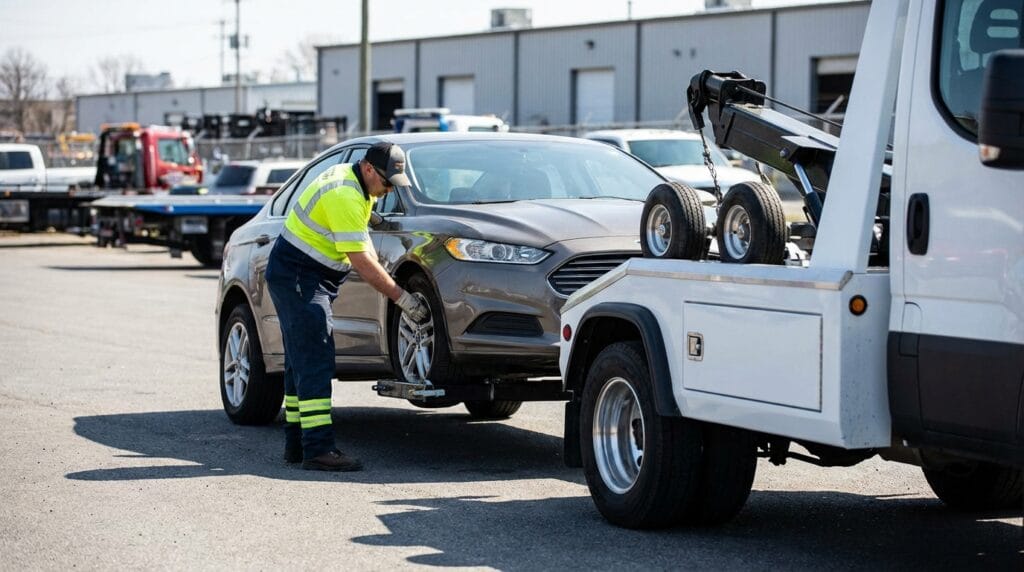
As we navigate the roads of Mesa in early 2026, understanding the most efficient recovery methods for your vehicle is crucial for avoiding unnecessary repair costs after a breakdown. While flatbed trucks are a common sight, wheel lift towing remains one of the most versatile, agile, and cost-effective solutions available when handled by experienced professionals.
Table of Contents
Understanding the Mechanics of Wheel Lift Towing
Gone are the days of the old “hook and chain” tow trucks that were notorious for scratching bumpers and straining vehicle frames. Modern wheel lift towing is a sophisticated evolution of that concept. It utilizes a metal yoke that slides underneath the front or rear wheels of the vehicle. This yoke is powered by a hydraulic lift system that raises the vehicle’s drive wheels off the ground, leaving the other two wheels to roll freely.
This method is particularly popular in urban environments like Mesa. Because the equipment is less bulky than a massive flatbed, wheel lift trucks can maneuver into tight spaces, low-clearance parking garages, and narrow driveways where larger trucks simply cannot fit.
The Step-by-Step Process: How It Is Done Correctly
To ensure the safety of your vehicle and other drivers on the road, correct procedure is non-negotiable. At Tow Mesa, we adhere to a strict protocol. Here is a detailed look at how we utilize wheel lift towing correctly to transport your vehicle safely:
- Assessment of Drivetrain: The operator must first identify if the vehicle is Front-Wheel Drive (FWD), Rear-Wheel Drive (RWD), or All-Wheel Drive (AWD). This determines which end of the car must be lifted.
- Positioning the Truck: The tow truck backs up squarely to the disabled vehicle. Misalignment here can cause tracking issues during transport.
- Deploying the Yoke: The hydraulic boom extends, lowering the metal yoke to the ground. The operator slides the yoke underneath the tires of the drive wheels.
- Securing the Wheels: Steel pins or locking mechanisms are engaged to close the yoke around the tires. Heavy-duty straps or wheel nets are then ratcheted down over the tires to secure them firmly to the lift.
- Lifting and Safety Chains: The vehicle is lifted just enough to clear the ground. Safety chains are attached to the frame of the towed vehicle as a fail-safe backup.
- Lighting and Signals: Auxiliary towing lights are attached to the rear of the towed vehicle to ensure brake lights and turn signals are visible to following traffic.
Critical Safety Considerations: AWD and 4WD Vehicles
One of the most common questions we receive in 2026 concerns modern drivetrains. Can you use wheel lift towing on an All-Wheel Drive vehicle? The short answer is: usually not without extra equipment.
If an AWD or 4WD vehicle is towed with two wheels rolling on the ground, the transmission acts as if the wheels are turning at different speeds. This can cause severe, often catastrophic, damage to the transmission and differential components. To use a wheel lift truck on these vehicles correctly, “dollies” must be used. These are pop-up wheels placed under the non-lifted tires so that all four wheels are off the pavement.
Quick Guide: Towing Method by Drivetrain
| Vehicle Type | Wheel Lift Procedure | Risk Level (Without Dollies) |
|---|---|---|
| Front-Wheel Drive (FWD) | Lift Front Wheels | Low |
| Rear-Wheel Drive (RWD) | Lift Rear Wheels | Low |
| All-Wheel Drive (AWD) | Requires Dollies | Extreme |
| 4×4 (Four-Wheel Drive) | Requires Dollies or Disconnected Driveshaft | High |
Why Choose Wheel Lift Towing in 2026?
As we settle into January 2026, many drivers are looking for ways to recover from holiday spending. Wheel lift towing is often more affordable than flatbed towing because the trucks are more fuel-efficient and easier to operate. It is the ideal choice for:
- Short-distance transport: Moving a car to a local mechanic in Mesa.
- Tight extractions: Pulling a vehicle out of a parallel parking spot or a crowded apartment complex.
- Low clearance areas: Parking garages where the ceiling height prevents a flatbed from raising its bed.
Furthermore, technology in 2026 has improved the hydraulic precision of these lifts, allowing for a smoother ride than ever before. The “yoke” design touches only the rubber of your tires, ensuring that your bumper, grill, and undercarriage remain untouched and undamaged.
Dos and Don’ts for Drivers
If you find yourself waiting for a tow truck, knowing what to do can speed up the process. Here is how you can help ensure the wheel lift towing process goes smoothly:
- DO engage your parking brake until the tow truck is in position to prevent rolling.
- DO straighten your wheels. If the wheels are turned sharply, it is difficult to secure the yoke.
- DON’T stay inside the vehicle during the lift. For safety reasons, it is best to stand clear of the equipment.
- DON’T attempt to help the operator attach chains or straps unless asked. Modern equipment is powerful and dangerous to the untrained.
Reliable Towing in Mesa, AZ
Correctly utilizing a wheel lift requires training, precision, and the right equipment. At Tow Mesa, our team is trained to identify the specific needs of your vehicle’s make and model instantly. We ensure that whether you drive a compact sedan or a heavy-duty work truck, the towing method used will protect your investment.
Winter in Arizona may not bring blizzards, but battery failures and mechanical issues are common in January. When you need a quick, safe, and professional recovery, trusting a company that understands the nuances of wheel lift towing is your best defense against further vehicle damage.
If you are stranded or need to move a vehicle across town, don’t hesitate to reach out to our professional team for immediate assistance. You can call us directly at 480-725-5862 for 24/7 service, or if you have a scheduled transport need, please click here to request a specialized towing quote online.