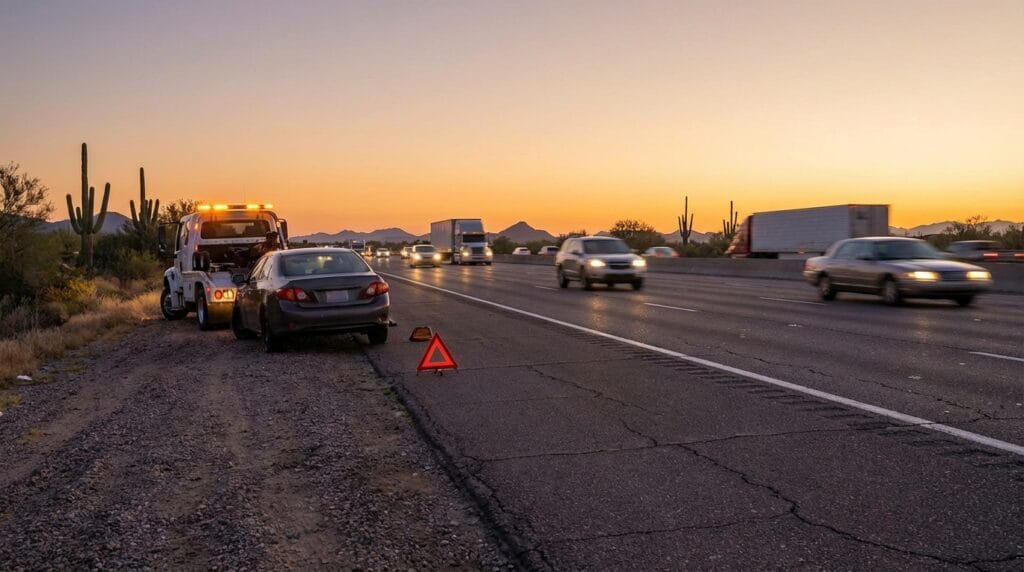
The shoulder of the Loop 202 is not a workshop; with traffic screaming past at 80 mph just feet from your back, it is a high-stakes gamble where the house always wins. When a blowout leaves you stranded on a Mesa highway, calling for a professional tire change service is not a luxury—it is a critical safety decision that separates a minor delay from a life-altering tragedy.
Table of Contents
Key Concept: The “Kill Zone” Definition
In the towing industry, we refer to the highway shoulder—specifically the three-foot buffer between the white line and the gravel—as the “Kill Zone.” This isn’t dramatic terminology; it is an operational reality.
For Mesa drivers, a tire change service is often viewed as a convenience for those who don’t know how to use a lug wrench. This definition is dangerously outdated. In 2025, professional tire service is about risk transfer. When you hire Tow Mesa, you are not just paying us to spin lug nuts; you are paying us to place our heavy-duty trucks, high-visibility beacons, and trained operators between your family and oncoming traffic. We effectively build a temporary steel wall around your vehicle so the work can be done without you stepping into the lane of travel.
Deep Dive into Strategy & Data: The Physics of Roadside Risk
The decision to attempt a DIY tire change on US 60 or the Loop 101 often ignores the raw physics of modern traffic. Reaction times at highway speeds are measured in milliseconds, and distracted driving statistics in Arizona remain alarmingly high.
The 2024 Arizona Safety Landscape
Recent data from the Arizona Department of Transportation (ADOT) and national safety reports highlight why the roadside is no place for pedestrians.
- 1,228 Fatalities: In 2024, Arizona saw over 1,200 traffic fatalities [1]. A significant portion of these occur on high-speed arteries where disabled vehicles create bottlenecks.
- Responder Strikes: Despite the “Move Over” law, there were 90 reported near-misses or crashes involving roadside responders in Arizona in 2024 [2]. If professionals with light bars and sirens are getting hit, a civilian in a dark sedan has virtually no defense.
- Heat Impact: Arizona asphalt can reach 150°F in the summer. This extreme heat weakens the rubber of your spare tire (if it’s under-mounted) and can cause makeshift jacks to sink into the melting tar, causing the vehicle to collapse.
DIY vs. Professional: The Exposure Gap
The following table illustrates the “Time on Target”—the amount of time a human body is exposed to lethal traffic during a tire change.
| Metric | DIY Attempt (Average Driver) | Professional Tow Mesa Service |
|---|---|---|
| Equipment Setup | 10–15 Minutes (Finding jack, reading manual) | 2 Minutes (Hydraulic floor jacks, impact guns) |
| Lug Nut Removal | 10–20 Minutes (Struggling with seized nuts) | 30 Seconds (High-torque pneumatic tools) |
| Total Exposure Time | 30–45 Minutes | < 8 Minutes |
| Visibility | Low (Hazard lights only) | High (Strobes, cones, reflective gear) |
| Vehicle Stability | Poor (Scissor jack on uneven gravel) | Excellent (Industrial jacks + wheel chocks) |
Actionable Steps: Protocol for a High-Speed Blowout
If you experience a rapid depressurization or blowout in Mesa, your immediate actions dictate your survival odds. Do not immediately brake and pull over.
- Maintain Control: Grip the wheel firmly. A blown tire will pull the car violently to one side. Do not slam the brakes; this causes spin-outs. Ease off the gas and let the car slow naturally.
- Limp to Safety: If possible, destroy the rim. It is better to grind a $200 alloy wheel into dust by driving on it for an extra mile to reach an exit ramp than to stop on a narrow shoulder. Your life is worth more than the wheel.
- The “Right” Shoulder: If you cannot exit, aim for the right shoulder. Never stop on the left (median) shoulder; it is the “suicide lane” with fast traffic on both sides.
- Stay Inside: Once stopped, turn on hazards. Do not exit the vehicle. If you have a flat on the driver’s side, stepping out puts you directly in traffic.
- Call for Support: Dial 480-725-5862. Tell our dispatch you are in a dangerous location on the highway. We prioritize these calls over safe-location tows.
Nuance, Counter-arguments & Expert Opinions
“I have AAA, I’ll just wait.” While roadside clubs are valuable, their response times in Mesa can vary during peak heat or rush hour. Waiting 90 minutes on the shoulder of the I-10 increases your cumulative risk exposure. Independent local operators like Tow Mesa often have faster ETA capabilities because our fleet is decentralized across the East Valley.
“I can change it myself to save money.” We respect self-reliance, but modern vehicles fight you.
- Seized Lugs: Mechanics often overtighten lug nuts with impact guns. The L-shaped wrench in your trunk provides insufficient leverage to break them loose, leading to slipped wrenches and knuckles skinned against asphalt.
- The “Spare” Reality: When was the last time you checked the pressure in your spare? National data suggests 20% of spares are under-inflated or flat [3]. We carry onboard air compressors to inflate your spare before installation—something a DIY attempt cannot fix.
- Locking Lugs: Many Mesa drivers realize too late that they don’t have the key for their wheel locks. We carry universal lock removal kits to bypass this issue without damaging the rim.
Expert Opinion: “The most dangerous tool in your car is the scissor jack,” says Mark R., a 15-year tow operator in Maricopa County. “They are designed for flat concrete garage floors, not the sloped, gravel-strewn shoulder of the Beeline Highway. We see cars fall off these jacks constantly.”
Future Outlook: The End of the Spare Tire?
The tire change service industry is evolving as vehicle manufacturers phase out spare tires to save weight and meet fuel economy standards.
- The Rise of Inflator Kits: Many new cars in Mesa come with “goo” kits instead of spares. These are useless against sidewall blowouts (common in Arizona heat). This trend is driving a higher demand for towing services rather than roadside changes.
- Run-Flat Dependency: Run-flat tires allow you to drive 50 miles at zero pressure, but they are expensive and ride harsh. As they become standard, the “roadside change” may become a “roadside escort” to a tire shop.
- Mobile Tire Installation: The future isn’t just changing to a spare; it’s bringing a new tire to the roadside. While currently a premium niche, we anticipate this becoming standard for luxury EV fleets in the East Valley by 2030.
Don’t Be a Statistic—Let Us Be Your Shield
A flat tire is an inconvenience; a highway accident is a catastrophe. In the blistering heat of a Mesa afternoon or the chaotic rush of the evening commute, the smartest tool in your kit is your phone.
We treat every highway call as a tactical operation. We position our trucks to deflect traffic, we wear the gear that demands attention, and we execute the job with the speed that safety requires.
Stuck on the 202? Don’t risk the shoulder. Call Tow Mesa immediately: 480-725-5862 Request Service Online: Contact Us