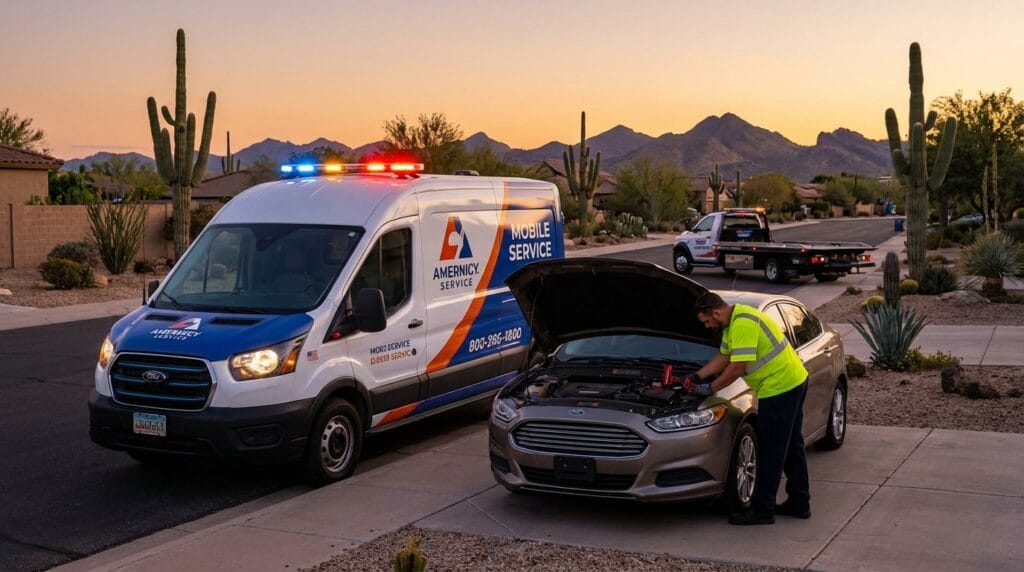
Nothing disrupts a Mesa morning commute faster than the hollow click of a starter motor refusing to turn over. When you turn that key or press the ignition button, you are relying on a chemical reaction that the Arizona climate actively works to destroy, making on-site battery replacement a critical service rather than a luxury.
Table of Contents
The Arizona Effect: Why Mesa Batteries Die Young
In most parts of the country, drivers worry about cold cranking amps (CCA) to fight freezing winters. In Mesa, the enemy is heat, but the victim is often discovered during a January cold snap. High ambient temperatures—common for eight months of the year in the Valley—accelerate the chemical reaction inside lead-acid batteries. This causes the liquid electrolyte to evaporate and the internal lead plates to corrode.
When temperatures drop in January, the oil in your engine thickens, requiring more power to crank. A battery weakened by the previous summer’s heat simply cannot deliver that surge. We call this the “Heat Tax.” While the national average for battery life hovers around three to five years, in Mesa and the greater Phoenix area, the average lifespan plummets to roughly 30 months [1]. If your battery is three years old and you park outside near Loop 202, you are driving on borrowed time.
The Mobile Advantage
Historically, a dead battery meant calling a tow truck, hauling the vehicle to a repair shop, waiting in a lobby, and paying for both the tow and the service. That model is obsolete. Mobile battery replacement brings the shop to the roadside. We diagnose, remove, and replace the unit right where you are parked, whether that’s your driveway in Las Sendas or a parking lot off Southern Avenue. This approach cuts downtime by 60% and eliminates the towing fee entirely.
Deep Dive into Strategy & Data: The Economics of Replacement
Replacing a battery seems simple until you analyze the total cost of ownership and the logistical friction involved in the traditional repair model. Smart fleet managers and savvy residents in Mesa have shifted toward mobile installation because the math favors immediate resolution over transport.
The following data breakdown illustrates the cost and time differential between traditional shop replacement and mobile service in 2026.
| Cost/Time Factor | Traditional Shop Visit | Mobile Battery Service |
|---|---|---|
| Towing Cost | $95 – $150+ (without membership) | $0 (Service vehicle comes to you) |
| Labor Rate | $120/hr (Shop minimums apply) | Included in service quote |
| Downtime | 2 – 4 Hours (Tow + Wait time) | 45 – 60 Minutes |
| Battery Markup | High (Captive audience pricing) | Competitive (Market pricing) |
| Risk | Potential damage during towing | Zero transport risk |
The AGM vs. Flooded Debate
The strategy for longevity in Mesa involves choosing the right chemistry.
- Flooded Lead-Acid: The standard “wet” battery. These are cheaper upfront but suffer high evaporation rates in Arizona heat. They are the most common failure point we see.
- Absorbent Glass Mat (AGM): In these batteries, the electrolyte is suspended in fiberglass mats. They are spill-proof, vibrate less, and resist heat significantly better than flooded units.
- Recommendation: For vehicles parked outside in Mesa, upgrading to an AGM battery can extend the replacement interval by 12-18 months, offsetting the higher initial hardware cost [2].
Actionable Steps & Methodology: Diagnosing the Failure
Before you commit to a new unit, you must confirm the battery is actually the culprit. Throwing parts at a problem is expensive and ineffective.
- Visual Inspection: Pop the hood. Look for white or blue powder around the terminals. This is corrosion (lead sulfate), which creates resistance. Sometimes, a simple cleaning with a wire brush restores the connection. Check the casing for bulging sides—a sign the internal plates have warped from heat or freezing.
- The Voltage Test: If you have a multimeter, set it to DC volts. A healthy, fully charged battery should read 12.6 volts or higher with the engine off. If it reads 12.2 volts, it is only 50% charged. Below 12.0 volts, it is effectively dead.
- The Load Test: Voltage tells only half the story. A battery can show 12.6 volts but fail to deliver current under load (amperage). We use carbon pile load testers to simulate the starter’s draw. If the voltage drops below 9.6 volts during cranking, the battery needs immediate replacement.
- Memory Saver Protocol: Modern vehicles are computers on wheels. Disconnecting the battery can wipe out radio presets, seat positions, and even engine idle learning parameters. We utilize a memory saver device plugged into the OBD-II port to maintain system voltage during the swap, preserving your settings.
- Terminal Protection: After installing the new unit, we apply a dielectric grease or battery terminal spray. In Mesa’s dusty environment, this barrier prevents moisture and dirt from creating new corrosion.
If you are unsure about performing these tests safely, our jump start service team can perform a diagnostic check before initiating a replacement.
Nuance, Counter-arguments & Expert Opinions
A dead car does not always equal a bad battery. One of the most common misdiagnoses we encounter involves the alternator.
The Alternator Trap
The battery starts the car; the alternator keeps it running. If your car starts with a jump but dies shortly after the cables are removed, your alternator is likely failing to charge the system. Replacing the battery in this scenario is a waste of money—the new battery will simply drain until the car dies again. We verify alternator output (typically 13.5 to 14.5 volts) before condemning the battery.
The “Just Drive It” Myth
Many drivers believe that driving a car for 30 minutes will recharge a dead battery. While this can top off a healthy battery that was drained by leaving the lights on, it cannot fix a damaged one. Once a lead-acid battery has been deeply discharged, sulfation crystals harden on the plates. The vehicle’s alternator is designed to maintain a charge, not resurrect a dead unit. Forcing the alternator to charge a bad battery places immense strain on the alternator, potentially causing a $600 part to fail because of a $150 battery problem [3].
Parasitic Drains
If you replace a battery and it dies within a week, you likely have a parasitic drain—a glove box light stuck on, a faulty alarm system, or an aftermarket stereo drawing power when the car is off. In these cases, swapping batteries is a bandage on a bullet wound. Specialized electrical diagnostics are required.
Future Outlook & Trends: 12V in an EV World
As we look toward 2027 and beyond, the nature of battery service is shifting. Even Electric Vehicles (EVs) utilize a standard 12-volt battery to power accessories, lights, and the computers that engage the main high-voltage pack.
- The EV 12V Failure: When the 12V battery in a Tesla or Chevy Bolt fails, the car will not start, even if the main battery is 100% charged. We are seeing an uptick in service calls for these specific units.
- Lithium-Ion Starter Batteries: High-performance and luxury vehicles are moving away from lead-acid entirely, adopting Lithium Iron Phosphate (LiFePO4) 12V batteries. These are lighter and last longer but require specific charging protocols and are significantly more expensive to replace.
- Battery Management Systems (BMS): New cars require “battery registration.” When a new battery is installed, the car’s computer must be told that a new unit is present. If this step is skipped, the alternator may overcharge the new battery, shortening its life. Our technicians are equipped with the scanners necessary to perform this registration on BMW, Audi, and Ford vehicles.
Final Diagnostics
The desert climate is unforgiving to automotive electronics. Waiting for total failure often leaves you stranded in a parking lot when you least expect it. By understanding the accelerated wear caused by Mesa’s heat and opting for mobile replacement, you bypass the logistical nightmare of towing and shop wait times. You save money, protect your alternator, and get back on the road immediately.
If you hear that hesitation when you turn the key, do not ignore it. The silence that follows is inevitable. Whether you need a simple jump start or a full installation of a heat-resistant AGM unit, we handle the heavy lifting.
Don’t wait for the click. Location: Mesa, AZ Call for Dispatch: 480-725-5862 Request Online: Tow Mesa Contact