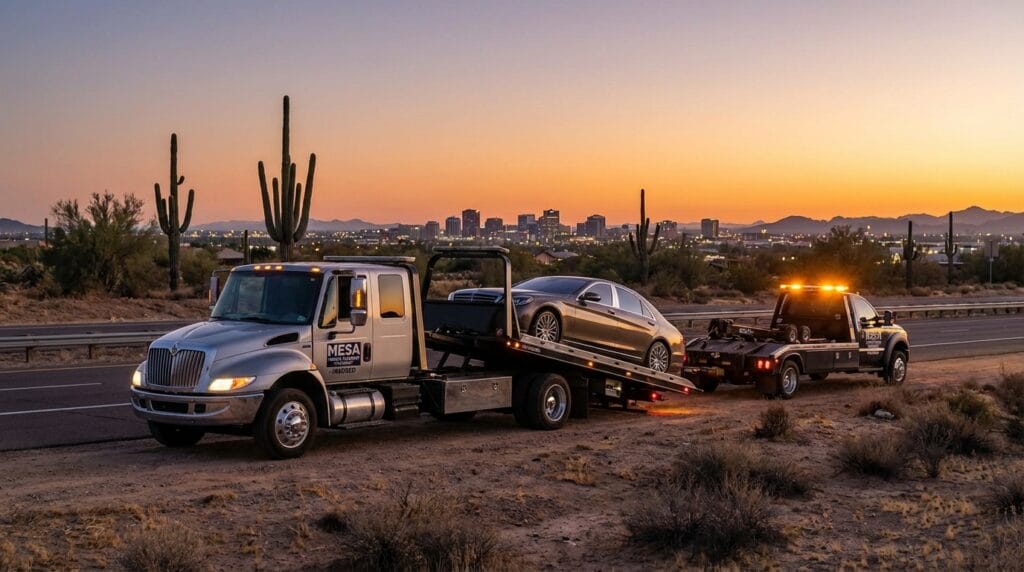
Moving a high-value asset across Maricopa County requires far more logistical precision than a standard roadside hook-up. Professional vehicle transport demands rigorous safety protocols and insurance coverage that many budget haulers simply fail to carry.
Table of Contents
Defining Specialized Asset Relocation
Vehicle transport differs fundamentally from emergency towing. While towing reacts to an immediate breakdown or accident on the US-60, transport is a proactive, scheduled logistical operation. In Mesa, this service frequently caters to distinct demographics: snowbirds moving vehicles seasonally, collectors transporting classic cars to auctions, and dealerships shuffling inventory between lots.
The core distinction lies in the equipment and the pace. Emergency towing prioritizes speed to clear the roadway. Transport prioritizes the preservation of the asset’s condition over distance. A standard wrecker drags a vehicle; a transport carrier carries it. This difference impacts everything from suspension stress to liability coverage.
For Mesa residents, understanding the specific geography is vital. Transporting a vehicle from the flat grid of downtown Mesa is different than hauling one out of the rugged terrain near the Superstitions. The carrier must account for ground clearance, loading angles, and securing mechanisms that prevent shifting during transit on heated asphalt.
The Logistics of Transport: Data & Strategy
Many vehicle owners assume all flatbeds offer identical protection. This assumption leads to disputes. The method of securement—how the car is tied down—dictates the risk of damage.
Chassis vs. Wheel Strap Securement
Old-school operators often use chains attached to the vehicle’s frame (chassis). In modern vehicles, specifically unibody constructions found in most sedans and crossovers, excessive tension on the frame can tweak alignment. We utilize wheel strap systems. These secure the tire to the deck, allowing the vehicle’s own suspension to absorb road bumps rather than the chassis taking the hit.
Comparative Risk Analysis: Open vs. Enclosed Transport
| Feature | Open Carrier (Standard) | Enclosed Carrier (Premium) |
|---|---|---|
| Exposure | High (Road debris, sun, rain) | None (Climate controlled options) |
| Cost Basis | Baseline | 40-60% Premium |
| Clearance | Standard Ramps | Hydraulic Lift Gates (Low clearance) |
| Insurance | General Cargo Liability | High-Value Specialty Coverage |
| Best For | Daily Drivers, SUVs | Classics, Exotics, Fresh Paint |
The Hidden Cost of “Terminal-to-Terminal”
Aggregators often lower prices by utilizing “terminal-to-terminal” shipping. Your vehicle sits in a storage yard until a truck is full. This increases the risk of theft, vandalism, and weather damage. We prioritize direct transport. The truck that picks up your vehicle in Mesa is the truck that delivers it. This minimizes handling. Every time a car is loaded or unloaded, the risk of damage increases by approximately 15% [1].
Executing a Safe Transport: Methodology
Securing a vehicle for transport requires a systematic approach to liability and physical safety. Do not hand over keys without a paper trail.
- The Bill of Lading (BOL) Audit
The BOL is your contract and your receipt. It must document the pre-existing condition of the vehicle in excruciating detail. If a scratch is not noted on the pickup BOL, the carrier is liable. If a dent is noted, you cannot claim it later. Photographs are mandatory. Take time-stamped photos of every panel, the odometer, and the interior before the driver loads the vehicle.
- Fluid and Battery Preparation
Unlike a parked car, a transported vehicle is subject to vibration and angle changes. Leaks are a liability. Carriers can refuse vehicles with active fluid leaks as they pose a fire hazard and slip risk for other cargo. Ensure fuel levels are around 1/4 tank. This reduces weight (saving fuel costs) while leaving enough for loading and unloading. A full tank adds unnecessary payload strain.
- Disable Toll Tags and Alarms
A car alarm going off on a hauler is a nuisance for the driver and drains the battery. Disable all anti-theft systems. Remove toll tags (EZ Pass, etc.). If left active, these tags can register tolls as the carrier drives under gantries, racking up charges for a trip you aren’t driving.
- Insurance Verification
Ask for the carrier’s Certificate of Insurance (COI). Verify “Cargo” coverage, not just “Auto Liability.” Auto liability covers the carrier’s truck if they hit someone; Cargo coverage protects your vehicle while it is on their truck. Federal regulations require carriers to maintain specific minimums, but these minimums often fall short of the value of a luxury vehicle or restored classic [2].
Nuance: The Broker vs. Carrier Conflict
The vehicle transport industry is plagued by the broker model. When you search online for “car shipping,” the top results are usually brokers, not actual carriers. Brokers take your deposit and post your job to a load board, hoping a trucker will accept it for the remaining fee.
The Accountability Gap If damage occurs, the broker often claims they were merely the “arranger” and holds no liability. The carrier might be an unknown sub-contractor with questionable insurance. Working directly with a local Mesa-based provider ensures you know exactly who is handling your property. We own our assets. The driver you meet works for us, not a third-party algorithm.
Counter-Argument: Is Enclosed Always Necessary? Some experts argue that for trips under 500 miles, enclosed transport is overkill for standard vehicles. We agree. Arizona’s weather, while hot, is predictable. Unless you are moving a vehicle with exposed interior components or fresh, uncured paint, a standard flatbed with proper wheel straps is sufficient and cost-effective. The primary enemy in Mesa is the sun, not salt or hail.
Trends: EV Transport and Digital Tracking
As of late 2025, the transport landscape is shifting due to the electrification of the fleet and consumer demand for transparency.
Electric Vehicle (EV) Weight Displacement EVs are significantly heavier than combustion vehicles due to battery packs. A standard flatbed designed for a Toyota Camry may struggle with the point-loading weight of a Hummer EV or Rivian. Transporting EVs requires equipment rated for higher gross vehicle weight ratings (GVWR). Furthermore, specific tie-down points are required to avoid damaging the battery casing located at the bottom of the chassis.
Fire Risk Protocols Carriers are now adopting stricter protocols for damaged EVs. A compromise in the battery pack of a transported EV creates a thermal runaway risk. We inspect EVs for undercarriage damage before loading. If the battery structure is compromised, specialized containment transport is required, not a standard tow [3].
Real-Time Telematics The days of “it will get there when it gets there” are ending. Customers expect Amazon-level tracking. We utilize GPS integration that allows dispatch to monitor the exact location of the transport unit. This provides accurate ETAs and accountability regarding speed and route choice.
Securing Your Asset’s Journey
Selecting a partner for vehicle relocation is a decision based on trust and technical capability. The lowest bid often comes with the highest deductible or the vaguest delivery window. Your vehicle is likely your second most valuable asset. Treating its transport with the same scrutiny as a real estate transaction prevents financial loss.
At Tow Mesa, we operate with company-owned trucks and vetted drivers who understand the intricacies of Arizona’s roads and the specific needs of modern suspension systems. Whether you are moving a project car to a shop for automobile repair or sending a sedan to a family member, we ensure the condition at drop-off matches the condition at pick-up.
For a quote on local or regional transport that prioritizes asset preservation, contact our dispatch team.
Mesa Vehicle Transport Operations Call: 480-725-5862 Schedule Online: Tow Mesa Contact