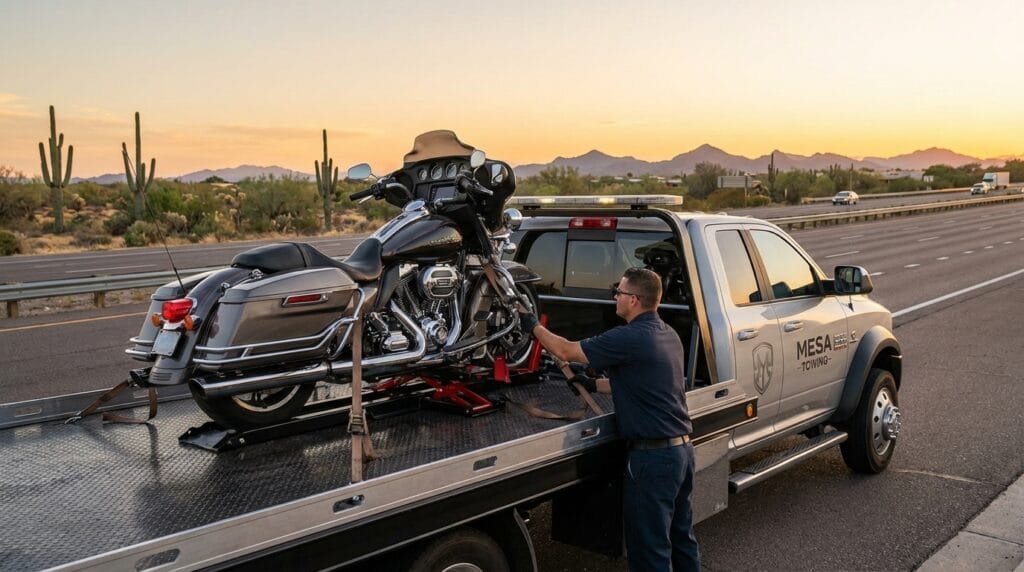
You are stranded on the shoulder of the Loop 202, the asphalt is radiating 150-degree heat, and your bike won’t start. The last thing you need is a tow operator treating your vintage cruiser or high-performance sportbike like a rusted sedan. We understand that towing a motorcycle requires specific geometry, specialized equipment, and a level of care that standard towing lacks.
Table of Contents
What is Specialized Motorcycle Towing?
Motorcycle towing is the specialized process of transporting two-wheeled vehicles using stabilization equipment that prevents suspension damage and structural stress. Unlike standard vehicle towing, which relies on pulling a chassis onto a flatbed, proper motorcycle transport requires a multi-point securement system. This involves wheel chocks to lock the front tire in place, soft loops to protect handlebars and fairings, and precise ratchet strap tensioning that compresses the suspension enough to hold the bike stable without blowing out fork seals.
The Physics of Safe Transport: Data & Strategy
Many riders attempt to load bikes into pickup trucks or use improper trailers, leading to drops and thousands of dollars in repairs. Professional recovery focuses on the “Triangle of Stability.” This concept dictates that the tie-down points must create equal tension from angles that prevent lateral movement while absorbing road shock.
Here is why the equipment matters:
- Hydraulic Lift Gates vs. Ramps: steep ramp angles are the enemy of low-clearance cruisers and sportbikes. Hydraulic lifts eliminate the “break-over” angle that scrapes underbellies and exhaust pipes.
- Soft Loops vs. Metal Hooks: Metal hooks on handlebars scratch chrome and damage wiring harnesses. Soft loops create a secure extension that protects the finish.
- Suspension Compression Ratio: We target a 40-50% fork compression. [1]. Less than this allows the hook to jump off during bumps; more than this pressurizes the fork oil, leading to blown seals.
- Mesa-Specific Heat Factors: In Arizona, extreme heat affects tire pressure and strap integrity. We inspect straps for UV damage daily because a snapped strap on the US 60 spells disaster.
Comparative Analysis: Towing Methods
We analyzed the risk factors associated with common transport methods to highlight why professional flatbed service remains superior.
| Method | Stability Rating | Risk to Suspension | Typical Use Case |
|---|---|---|---|
| Flatbed with Wheel Chock | High | Low (Controlled) | Professional Recovery |
| Tow Dolly (Front Wheel Lift) | Very Low | High (Rear Tire Wear) | Emergency / Improper |
| Pickup Truck Bed | Medium | Medium (Loading Risk) | DIY Transport |
| Trailer Hitch Carrier | Low | High (Frame Stress) | Dirt Bikes / Lightweights |
Protocol for Secure Motorcycle Recovery
When Tow Mesa arrives on the scene, we follow a strict protocol designed to protect your asset. This is not about getting it done fast; it is about getting it done right.
- Site Assessment and Stabilization: Before we lower the bed, we assess the gradient of the road. Loading a bike on an incline requires blocking the rear wheel to prevent roll-back before straps are applied.
- The Four-Point Tie-Down System: We utilize four distinct anchor points. Two front straps pull forward and out to the chock, stabilizing the steering head. Two rear straps pull slightly forward to keep the rear tire planted, preventing the “fishtail” effect during transport [2].
- Neutral Gear Verification: We ensure the transmission is in neutral to prevent gearbox damage as the bike settles. For shaft-driven bikes, this is critical to avoid drivetrain shock.
- Fairing Protection Check: We route straps away from plastic fairings. If contact is unavoidable, we use microfiber padding to prevent friction burns caused by road vibration.
- Post-Load Inspection: After driving one mile, a conscientious operator pulls over to re-check strap tension. Nylon stretches, and loads settle. This step catches loose straps before they become failures.
Nuance and Common Misconceptions
A prevalent myth in the riding community is that “towing kills your bike.” This usually stems from experiences with operators who treat a Harley Davidson like a Toyota Camry. The reality is that towing is often safer than riding a compromised machine.
The “Side Stand” Debate: You should never tow a motorcycle resting on its side stand. The stand is designed to support the static weight of the bike, not the dynamic G-forces of a moving truck. Transporting on the stand can crack the frame mount or bend the stand itself. We always tow the bike upright, balanced by tension.
The DIY Truck Ramp Risk: We see many Mesa residents attempting to push a 900-pound touring bike up a narrow aluminum ramp into a lifted truck. The failure rate here is high. If the bike tips halfway up, you cannot hold it. The resulting injury and damage far exceed the cost of professional roadside assistance.
Electric Motorcycles: EVs require different handling. High-voltage cables often run near traditional frame rails. Clamping onto these orange cables can cause catastrophic electrical failure or fire. Our team is trained to identify safe anchor points on electric models [3].
Future of Two-Wheel Logistics
The industry is shifting toward deck-lowering trailers and automated locking systems. We are seeing the introduction of “bar-harness” systems that slide over the grips to pull from the center of the handlebars, distributing the load more evenly than traditional hooks. Furthermore, as Mesa’s traffic density increases, the ability to rapidly clear motorcycle breakdowns from HOV lanes becomes a matter of public safety [4].
We are also adapting to the increasing width of rear tires on custom bikes. Standard wheel chocks often fail to secure a 300mm rear tire properly. We now carry adjustable chocks capable of securing everything from a skinny chopper front wheel to a massive custom rear tire.
Get Your Bike Home Safe
Your motorcycle is likely your pride and joy. Do not leave its safety to chance or improper equipment. Whether you ride a sportbike, a cruiser, or a custom chopper, we have the soft straps, the wheel chocks, and the expertise to transport it without a scratch. If you are stuck in Mesa or the surrounding valley, one call secures your ride.
Need immediate help?
Call Now: 480-725-5862
Request specialized motorcycle transport online