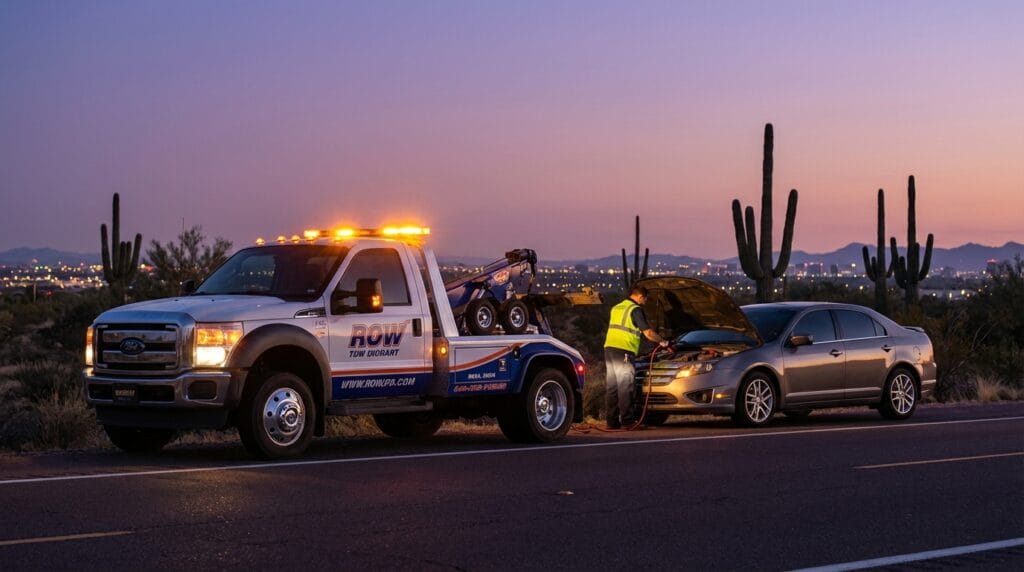
Nothing ruins a Mesa morning faster than the dreaded “click-click-click” of a dead ignition. It is November 29, 2025, and while our afternoon temperatures are mild, the cooler overnight lows are finally exposing the damage Arizona’s brutal summer heat inflicted on your vehicle’s battery. When you are stranded in a parking lot or your driveway, a professional jump start service is the safest bridge between being stuck and getting back on the road.
Table of Contents
Key Concept: Modern Voltage Delivery
A jump start service is effectively an external power injection designed to bypass a depleted lead-acid or AGM battery to engage the starter motor. In the context of Mesa, Arizona, this service is critical because it involves more than just connecting two cables. It requires precise voltage regulation to prevent frying the Electronic Control Unit (ECU) of modern vehicles. Unlike older cars, today’s vehicles—including hybrids and EVs with 12-volt auxiliary systems—are highly sensitive to power surges. A professional service utilizes regulated power packs rather than direct vehicle-to-vehicle transfers, mitigating the risk of electrical system failure.
The Silent Battery Killer: Heat Latency
Most drivers assume cold weather kills batteries. In reality, the heat destroys the internal structure, and the cold merely delivers the final blow. In Mesa, where pavement temperatures regularly exceeded 150°F just a few months ago, your battery fluid has likely evaporated, leading to internal corrosion.
Here is why your battery is failing right now:
- Fluid Evaporation: High heat causes the electrolyte solution in non-sealed batteries to vanish, exposing lead plates.
- Grid Corrosion: Heat accelerates the chemical reaction that breaks down the internal lead grid.
- Capacity Loss: By the time November arrives, the battery lacks the Cold Cranking Amps (CCA) necessary to turn the engine over in cooler morning air [1].
Below is a breakdown of how state-of-charge correlates with voltage readings, which helps diagnose if you need a simple jump or a full replacement.
Battery Voltage vs. State of Charge
| Voltage Reading | State of Charge | Action Required |
|---|---|---|
| 12.66V+ | 100% | Battery is healthy; check starter/alternator. |
| 12.45V | 75% | Functional, but capacity is dropping. |
| 12.24V | 50% | Risk zone. May require jump start in cold weather. |
| 12.06V | 25% | Critical low. Jump start service required immediately. |
| 11.89V | 0% | Dead. Sulfation likely permanent. |
The Protocol: Safe Jump Start Methodology
Attempting a jump start without a strictly defined process can be dangerous. According to safety data, thousands of injuries occur annually due to lead-acid battery explosions or shocks [2]. Our technicians follow a rigid safety protocol to protect both the operator and the vehicle.
- Visual Inspection: Before applying power, we check for bulging cases, leaking acid, or a “rotten egg” smell. If these exist, jumping the battery is dangerous and we will recommend towing instead.
- Terminal Cleaning: A layer of oxidation prevents a solid connection. We scrub the terminals to ensure the clamps make contact with the lead post, not just surface dirt.
- Positive Connection First: We connect the red (positive) clamp to the dead battery’s positive post first to minimize short-circuit risks.
- The Ground Connection: We never connect the black (negative) clamp to the dead battery’s negative post. This can spark and ignite hydrogen gas. Instead, we clamp to an unpainted metal surface on the engine block to complete the circuit safely [3].
- Voltage Stabilization: Once the vehicle starts, we do not disconnect immediately. We allow the alternator to stabilize the voltage for several minutes.
If you are unsure about performing these steps yourself, relying on our roadside assistance team ensures the job is done without risking your vehicle’s warranty.
Nuance: Why DIY Jumps Are Risky in 2025
The old logic of “any car can jump any car” is obsolete. Modern vehicles are computers on wheels. Connecting a 2025 luxury SUV to a 1990s pickup truck can cause a voltage spike that destroys the Infotainment system, the transmission control module, or the airbag sensors.
Hybrid and EV Awareness: Many Mesa drivers operate hybrids. While the high-voltage battery moves the car, a small 12-volt battery runs the electronics. If this 12-volt battery dies, the car will not start. However, jumping it incorrectly can damage the high-voltage converter. Professional equipment limits amperage to safe levels for these specific systems.
Furthermore, cheap consumer-grade jumper cables often lack the copper density (gauge) required to transfer enough current to start a large truck or SUV [4]. You might hook everything up correctly and still fail to start simply because the cables are creating too much resistance.
Future Outlook: The Shift to Lithium Technology
The industry is moving away from heavy, lead-acid booster packs toward high-density lithium-ion jump starters. These units deliver massive amperage in short bursts without the weight or bulk of traditional equipment. As we approach 2026, we are also seeing the rise of “smart” cables that detect polarity automatically, preventing the dreaded spark of a crossed connection.
However, even with advanced tech, the underlying chemistry of your car battery remains the weak link. As Mesa continues to experience extreme heat variance, the demand for reliable battery diagnostics and repair will only increase. We anticipate battery management systems (BMS) becoming standard in all ICE (Internal Combustion Engine) vehicles to predict failures before you get stranded.
Conclusion: Don’t Risk Your Electronics
A dead battery is an inconvenience; a fried electrical system is a catastrophe. If you are stuck in Mesa, AZ, do not rely on a stranger’s questionable cables or a cheap portable pack that hasn’t been charged in three years. You need professional grade equipment and a technician who understands the electrical architecture of modern vehicles.
We are ready to get you moving again safely. Save your alternator and your peace of mind.
Need a jump start right now?
- Call our dispatch immediately: 480-725-5862
- Request help online: Get Fast Jump Start Service Here