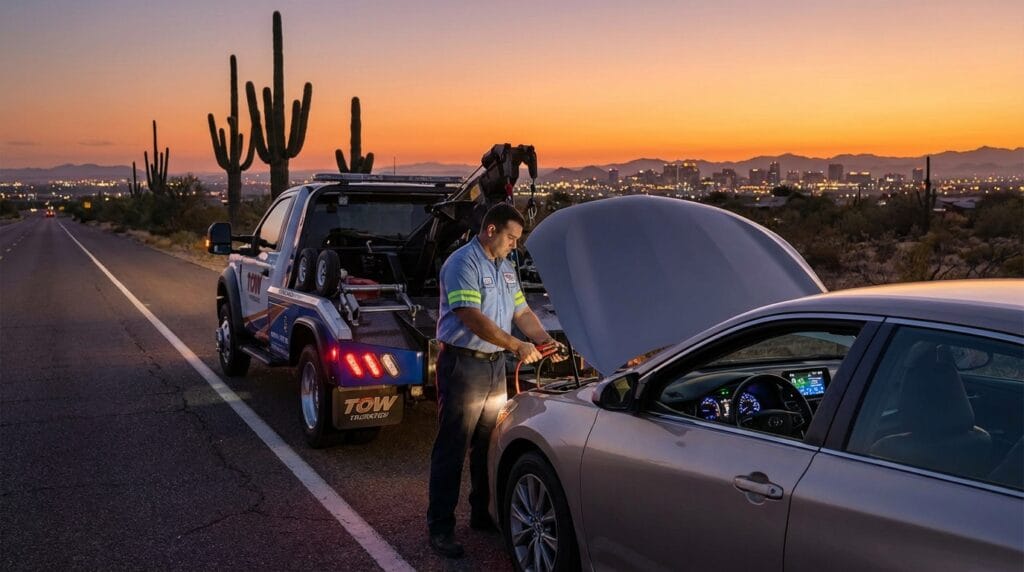
You know the sound—the hollow click-click-click echoing in a quiet Mesa parking lot when you turn the key. It’s the sound of a morning schedule collapsing, but before you reach for those rusty jumper cables in your trunk, pause. In 2025, attempting a DIY jump start service on a modern vehicle isn’t just a hassle; it is a financial gamble that could cost you thousands in fried electronics.
Table of Contents
The Arizona Battery Paradox: Heat Kills, Cold Buries
If you are a Mesa resident, you already know the desert sun is relentless, but you might not realize it is the primary assassin of your vehicle’s battery. While drivers in the Midwest worry about freezing temps, we deal with “The Arizona Battery Paradox.”
In Mesa, our summer temperatures—often exceeding 110°F—boil the electrolyte fluid inside your battery, damaging its internal lead plates. This damage is silent. The battery continues to function while the weather is hot because heat accelerates the chemical reaction, artificially boosting the battery’s output.
Then comes December. As Mesa’s overnight lows dip into the 40s [1], that heat-damaged battery suddenly faces a new challenge: cold oil. The engine is harder to turn over, requiring more cold cranking amps (CCA) than your weakened battery can deliver. The battery didn’t die this morning; it died in July. The December chill just signed the death certificate.
Typical Battery Lifespan:
- National Average: 3–5 years
- Mesa, AZ Average: 1.5–2.5 years
Deep Dive: The $3,000 Spark
The days of simply connecting “red to red, black to black” on a sturdy steel bumper are over. Modern vehicles are essentially rolling computer networks, often containing 50 to 100 Electronic Control Units (ECUs). These modules control everything from your fuel injection and transmission to your infotainment and airbags.
When you connect jumper cables from a running donor car to a dead one, you risk a voltage spike. If the donor car’s alternator kicks in hard, or if the cables spark upon connection, you can send a surge of electricity through the system.
The ECU Vulnerability
A standard 12-volt system is designed to handle… 12 volts. A surge can spike to 20+ volts in milliseconds.
| Component Risk | Potential Damage | Estimated Replacement Cost |
|---|---|---|
| Engine Control Unit (ECU) | Complete engine failure; car won’t start. | $1,000 – $4,500 |
| Infotainment Module | Loss of nav, radio, backup camera. | $800 – $2,500 |
| Body Control Module (BCM) | Windows, locks, and lights fail. | $600 – $1,500 |
| Alternator Diodes | Fried charging system on both cars. | $400 – $900 |
We have seen it happen in parking lots off US 60: a well-meaning Good Samaritan tries to help, and both vehicles end up on the back of our flatbeds.
Actionable Steps: The “Stop, Look, Smell” Method
Before you even consider opening the hood, perform this three-step diagnostic. It could save you from a dangerous situation or an expensive repair bill.
- The Light Test
Turn on your headlights. Are they dim? If they are bright but the car clicks, the issue might be your starter, not the battery. Jumping a car with a bad starter does nothing but heat up your cables.
- The Smell Test
Lean near the front grille. Do you smell rotten eggs? That is sulfur. It means the battery is leaking or venting hydrogen gas. Do not jump start this car. A single spark near a venting battery can cause an explosion. Call for professional jump start service immediately.
- The Corrosion Check
Pop the hood and look at the terminals. White or blue powder (corrosion) adds electrical resistance. Sometimes, simply wiggling the cable clamp to break through this crust is enough to get a connection. If the corrosion is severe, jumping it without cleaning it first is often futile.
Methodology for a Safer Jump (If You Must DIY)
If you have a portable lithium-ion jump pack (highly recommended over cables), follow this strict sequence to protect your ECUs:
- Connect Positive (+) Red clamp to the dead battery.
- Connect Negative (-) Black clamp to an unpainted metal ground on the engine block (NOT the negative battery terminal). This prevents sparks near the battery cells.
- Turn on the jump pack.
- Start the car.
- Disconnect in reverse order immediately.
Nuance: The Hybrid & EV Complexity
If you drive a hybrid (Prius, RAV4 Hybrid) or an EV (Tesla, Leaf), the stakes are higher. These vehicles have a small 12-volt battery that engages the high-voltage system. If that 12V dies, the car is a brick.
However, the 12V battery in many hybrids is buried in the trunk or under a seat, with specific “jump points” under the hood. Connecting cables directly to the wrong terminal on a hybrid inverter can destroy the regenerative braking system’s electronics.
- Counter-Argument: “But my grandfather always used jumper cables.”
- Expert Reality: Your grandfather’s ’72 Chevy didn’t have a Controller Area Network (CAN bus) system sensitive to millivolt fluctuations. Modern alternators are computer-controlled. Using an old-school “heavy duty” alternator to jump a modern car forces it to run at maximum output, which can overheat the diodes in the donor car’s alternator.
Future Outlook: The End of Jumper Cables?
The trend in roadside assistance is shifting away from traditional jump starts entirely.
- Supercapacitor Jump Starters: These devices don’t use a battery at all. They gather the weak residual energy remaining in your dead battery, amplify it, and dump it back into the starter in one quick burst. They are safer for electronics because they cannot “push” more voltage than the system holds.
- Battery Health Monitoring: New vehicles are beginning to transmit battery health data directly to your phone, alerting you weeks before failure.
- EV Mobile Charging: As EVs dominate Mesa roads, “out of juice” calls are replacing dead battery calls. We are equipping our fleets to handle mobile EV top-offs to get you to the nearest charger.
Getting Back on the Road
A dead battery in December is a Mesa tradition, but it doesn’t have to be a disaster. The cost of a professional service call is a fraction of the cost of a new ECU. When you hear that clicking sound, don’t panic—and don’t risk your car’s brain.
We prioritize roadside assistance safety above all else. Whether you are stuck at a trailhead near the Superstitions or in a driveway in downtown Mesa, we have the voltage-regulated equipment to start your car safely.
If the battery is too far gone, we can provide towing to a shop of your choice.
Stuck with silence? Call Tow Mesa: 480-725-5862 Request Service Online