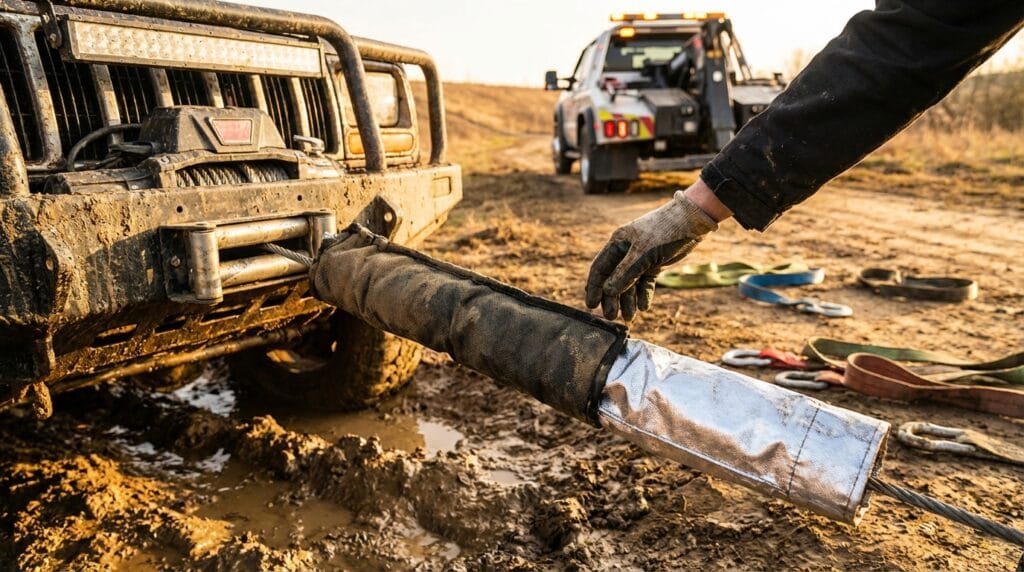
Getting stuck in thick, clay-heavy mud is a rite of passage for off-road enthusiasts, but getting out safely requires more than just brute force and a heavy foot on the gas pedal. Proper vehicle winching techniques are essential to recover your 4×4 without damaging your equipment or risking serious injury from a snapped line.
Table of Contents
Understanding the Physics of Deep Mud Recovery
Before unspooling your line, it is critical to understand why mud is notoriously difficult to escape. Unlike sand or snow, deep mud creates a powerful suction effect that acts against the undercarriage of your vehicle. In the recovery industry, we often refer to this as “mire resistance.”
If your truck weighs 5,000 pounds, deep mud suction can effectively double or even triple the load required to pull it free. This unexpected load spike is the primary reason why winch lines snap. A standard 9,500-lb winch might be sufficient for rolling a vehicle up a steep incline, but once that vehicle is buried to the frame in sludge, you are pushing the mechanical limits of your gear. Successful recovery relies on overcoming this suction slowly rather than jerking the vehicle free.
The Golden Rules of Rigging: Safety First
Snap-back is the most dangerous aspect of vehicle winching. If a steel cable or synthetic rope fails under tension, the stored kinetic energy transforms the line into a whip capable of causing catastrophic damage or fatality. To mitigate this, follow these non-negotiable safety protocols:
- Inspect the Line: Before every trip, check for frayed strands (on steel cables) or UV damage and abrasion (on synthetic ropes). In the winter months of 2026, also check for ice buildup which can cut synthetic fibers.
- Use a Line Damper: Place a winch weight, heavy blanket, or floor mat over the middle of the line. If the line snaps, gravity will pull the damper down, forcing the line to the ground rather than allowing it to whip back toward the windshield.
- Wear Heavy Gloves: Always wear leather gloves when handling the line to protect against burrs and wire splinters.
Steel Cable vs. Synthetic Rope: A Quick Comparison
Choosing the right equipment for the terrain is vital. Below is a comparison of how different line types handle deep mud recovery.
| Feature | Steel Cable | Synthetic Rope |
|---|---|---|
| Durability in Mud | Highly resistant to abrasion against rocks buried in mud. | Susceptible to internal abrasion if grit penetrates the fibers. |
| Snap Risk | Stores high kinetic energy; very dangerous if it breaks. | Stores less kinetic energy; drops dead faster upon breaking. |
| Maintenance | Requires lubrication; prone to kinks and rust. | Must be washed to remove mud grit; UV sensitive. |
The Secret Weapon: Using a Snatch Block
If you are truly buried, a single-line pull might not be enough. This is where mechanical advantage becomes your best friend. By utilizing a snatch block (a heavy-duty pulley), you can effectively double the pulling power of your winch while cutting the stress on the motor and the line in half.
To set this up, run the line from your vehicle to a snatch block attached to an anchor point (like a tree with a tree-saver strap), and then loop the line back to a solid recovery point on your vehicle. This “double-line pull” slows down the recovery speed but significantly increases torque, allowing you to break the mud’s suction without snapping your line. For professional vehicle winching operators, the snatch block is an indispensable tool for heavy recoveries.
Step-by-Step Recovery Process
Once you have assessed the suction, checked your gear, and decided on a rigging strategy, follow these steps to extract your 4×4:
- Secure a Solid Anchor: Find a live, sturdy tree or a large rock. Always use a tree-saver strap to prevent ring-barking the tree and damaging your line. Never wrap the winch cable around an anchor and hook it back onto itself.
- Connect the Remote: Whether wireless or wired, ensure you are standing in a safe zone (preferably the driver’s seat or well to the side, outside the potential snap-back radius).
- Take Up Slack: Slowly engage the winch to remove slack. Ensure the line is spooling neatly onto the drum. Cross-spooling can crush the line under tension.
- The Assist: If you have a second person, they can gently drive the vehicle while you winch. The goal is to have the wheels turn at the same speed as the winch pull. Do not spin the tires wildly, as this digs the hole deeper.
- Pulse the Winch: In heavy mud, run the winch for 30 to 60 seconds, then let it rest. This prevents the winch motor from overheating and allows the battery to recover.
Winter 2026 Considerations
Operating in January presents unique challenges. Mud often freezes over, creating a crust that can cut lines, or the mud underneath remains unfrozen while the top layer hardens, trapping the vehicle further. In these cold conditions, steel becomes more brittle, and battery efficiency drops. Ensure your vehicle’s battery is in top condition, as winching places a massive amperage draw on your electrical system.
Furthermore, if you are off-roading in the Mesa area or surrounding trails this winter, be aware that recent weather patterns may have shifted trail conditions unpredictably. What looks like a shallow puddle may be a deep sinkhole. Safe vehicle winching requires patience; rushing a recovery in freezing temperatures is a recipe for equipment failure.
When to Call the Professionals
Sometimes, despite the best gear and intentions, the suction is too great, or the mechanical failure is too severe to fix on the trail. Risking your vehicle’s frame or your personal safety is never worth it. Professional recovery services have rotators and heavy-duty wreckers designed to extract vehicles from the most precarious positions without causing further damage.
If you find yourself stuck beyond the capabilities of your equipment, don’t risk a dangerous line snap or a burnt-out transmission. Call the experts at Tow Mesa immediately at 480-725-5862 or click here to request a professional off-road recovery quote online.