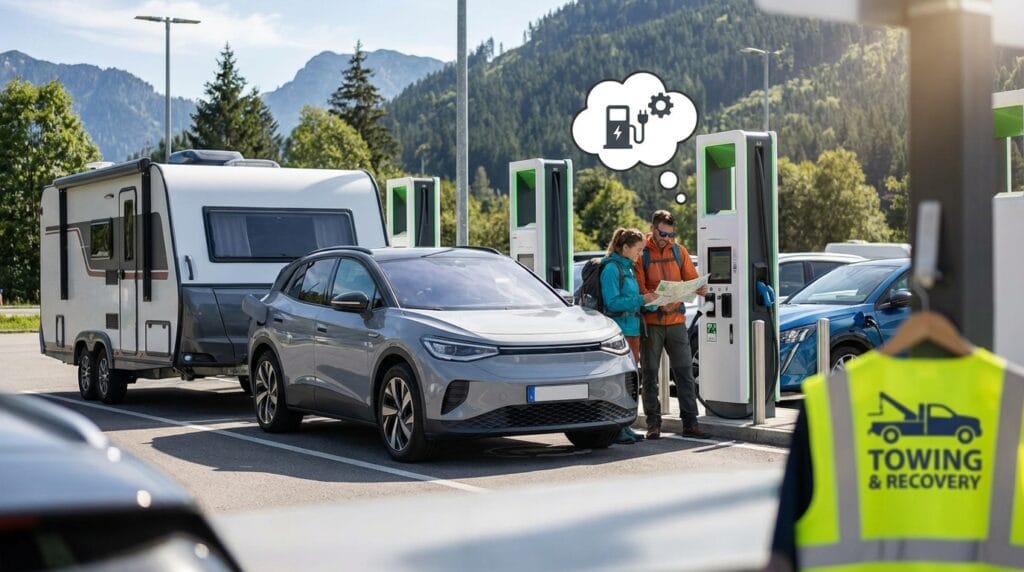
As we settle into 2026, the sight of silent powerhouses hauling campers and boats has become commonplace on Arizona highways, yet the specific challenges of electric vehicle towing remain a major learning curve for new owners. While electric trucks offer superior torque and stability compared to their gas counterparts, the anxiety of watching your range estimate drop faster than the temperature in January can turn a road trip into a logistical nightmare without the right preparation.
Table of Contents
The Physics of Power: Why Towing Drains Your Battery
Before you hit the road, it is crucial to understand the mechanics at play. In 2026, battery technology has improved significantly, with solid-state batteries becoming more accessible and energy density increasing. However, physics hasn’t changed. When you tow a trailer, you are fighting two main enemies: weight and aerodynamic drag.
Electric vehicles are incredibly efficient, converting over 85% of electrical energy into motion. Because they are so efficient, the extra energy required to pull a 5,000-lb trailer creates a much more noticeable percentage drop in range compared to a gas truck, which wastes most of its energy as heat anyway. Generally, you can expect electric vehicle towing to reduce your stated range by 30% to 50%, depending on the profile of your trailer.
The 2026 Landscape: Charging Infrastructure
The good news for Mesa drivers is that the charging landscape has matured. With the universal adoption of the NACS (North American Charging Standard) across almost all major manufacturers—from Ford to Rivian to GM—access to reliable Superchargers is no longer exclusive to one brand. However, infrastructure design still lags behind vehicle capability.
The biggest headache for EV towers is the physical layout of charging stations. Most spots are still “pull-in” rather than “pull-through.” This means if you need to charge mid-trip, you often have to unhitch your trailer, charge, and then hitch up again. To avoid losing your mind, use apps like PlugShare or A Better Route Planner (ABRP) and filter specifically for “trailer-friendly” or pull-through charging stalls.
January Towing: battling the Cold and the Load
Since we are currently in January, seasonal factors play a massive role in your towing efficiency. While Arizona winters are mild compared to the Midwest, temperatures in the mornings and evenings can dip significantly, affecting battery chemistry.
Cold batteries are less efficient and accept a charge more slowly. When you combine low temperatures with the high energy demand of electric vehicle towing, the impact is compounded. To mitigate this:
- Precondition your Battery: While your truck is still plugged into your home charger, schedule your departure time. This warms the battery using grid power rather than your precious range.
- Check Tire Pressure: Cold air compresses tires. Under-inflated tires on both your truck and trailer significantly increase rolling resistance.
- Heat Management: Use seat heaters instead of blasting the cabin heater to save auxiliary power.
Efficiency Comparison: Solo vs. Towing
To give you a realistic idea of what to expect, here is a breakdown of energy consumption based on current 2026 electric truck averages.
| Driving Scenario | Efficiency (mi/kWh) | Est. Range (300mi Battery) | Impact Level |
|---|---|---|---|
| Highway (Unloaded) | 2.0 – 2.4 | 280 – 300 miles | Baseline |
| Towing Low Profile (Boat/Flatbed) | 1.3 – 1.5 | 170 – 190 miles | Moderate |
| Towing High Profile (Box Camper) | 0.8 – 1.1 | 110 – 145 miles | Severe |
Strategies for a Stress-Free Haul
You can successfully tow heavy loads without range anxiety if you adjust your driving habits. The “speed penalty” in EVs is real. Drag increases exponentially with speed. Slowing down from 75 mph to 65 mph can improve your efficiency by 10-15%. In the world of electric vehicle towing, patience literally equals distance.
Additionally, utilize regenerative braking. When towing a heavy load downhill, your EV can recapture a significant amount of kinetic energy, feeding it back into the battery. This not only extends your range but also saves your mechanical brakes from overheating on steep descents.
When Things Don’t Go to Plan
Even with the best planning, things can go wrong. Perhaps a charger was out of order, or a headwind drained your battery faster than anticipated. If your EV runs out of charge while towing, the situation is more complex than running out of gas.
Most EVs require specific procedures to be towed to avoid damaging the electric motors. You cannot simply throw a strap on it and pull it with a buddy’s truck; the wheels often need to be stationary or lifted. At Tow Mesa, we understand the nuances of EV recovery. Whether it is flatbed towing to get your vehicle to the nearest fast charger or assisting with a trailer that needs to be transported separately, professional help is vital to protect your investment.
Successful EV towing in 2026 is about shifting your mindset from “fill up and go” to “plan and monitor.” By respecting the physics of the load and the current weather conditions, you can enjoy the incredible torque and silence of your electric truck on your next adventure.
Don’t let the fear of a depleted battery stop you from hauling your gear; simply plan ahead and know who to call if you need backup. If you find yourself stranded or in need of emergency roadside assistance, call us immediately at 480-725-5862. For scheduled long-distance transport or to move an immobilized EV, get a specialized EV towing quote from our experienced team today.