Exploring the backcountry alone offers an unmatched sense of freedom, but that solitude quickly turns into a serious challenge when your vehicle loses traction in deep mud or sand. Understanding the mechanics of self-reliance and having a solid plan for off road recovery is essential for any solo overlander looking to return home safely.
Table of Contents
The First Rule of Solo Recovery: Assessment Over Acceleration
It is January 2026, and depending on your elevation in the Mesa area, the trails can range from deceptive dry sand to slick, winter-rain mud. When forward momentum stops, the natural instinct is to slam on the gas pedal. As a solo driver, this is the worst thing you can do. Spinning your tires almost always digs the vehicle deeper, turning a minor snag into a chassis-deep burial.
Before you deploy any tools, step out of the vehicle (if safe) and assess the situation:
- Check your clearance: Are you high-centered on a rock or a ridge of hard-packed dirt?
- Analyze the terrain: Is the ground in front of you solid, or is it softer than where you are currently stuck?
- Identify anchor points: Look for large trees, boulders, or safe spots to bury a land anchor if winching becomes necessary.
Tire Pressure: The Simplest Force Multiplier
Before reaching for heavy equipment, start with physics. Lowering your tire pressure is often enough to drive out of a stuck situation. By airing down, you lengthen the tire’s footprint, significantly increasing the surface area and flotation over soft terrain like sand or snow.
While street pressure is typically 32–40 PSI, effective off road recovery often requires dropping down to 15–20 PSI, or even lower if you have beadlock wheels. This allows the tire to mold over obstacles rather than bouncing off them. Remember to air back up before hitting the pavement to avoid sidewall damage.
Traction Boards: The Solo Traveler’s Bridge
If airing down doesn’t provide enough grip, traction boards are your next line of defense. These nylon-reinforced boards act as a temporary road surface.
How to Use Them Effectively:
- Clear the path: Use a shovel to clear mud or sand from immediately in front of (or behind) the tires.
- Wedge the boards: Jam the traction boards as far under the tires as possible.
- Low gear, slow throttle: Engage 4-Low and gently apply the throttle. If the tires spin on the board, stop immediately to avoid melting the plastic nubs.
- Momentum: Once you catch traction, maintain steady momentum until you are on solid ground.
Winching Without Another Vehicle
When you are miles from help, a winch is an invaluable insurance policy. However, winching solo presents a unique problem: you have no other vehicle to anchor to. This is where environmental awareness becomes critical.
Tree Anchors: Always use a tree trunk protector (tree saver strap). Wrapping a steel cable or synthetic rope directly around a tree damages the tree and compromises the integrity of your line.
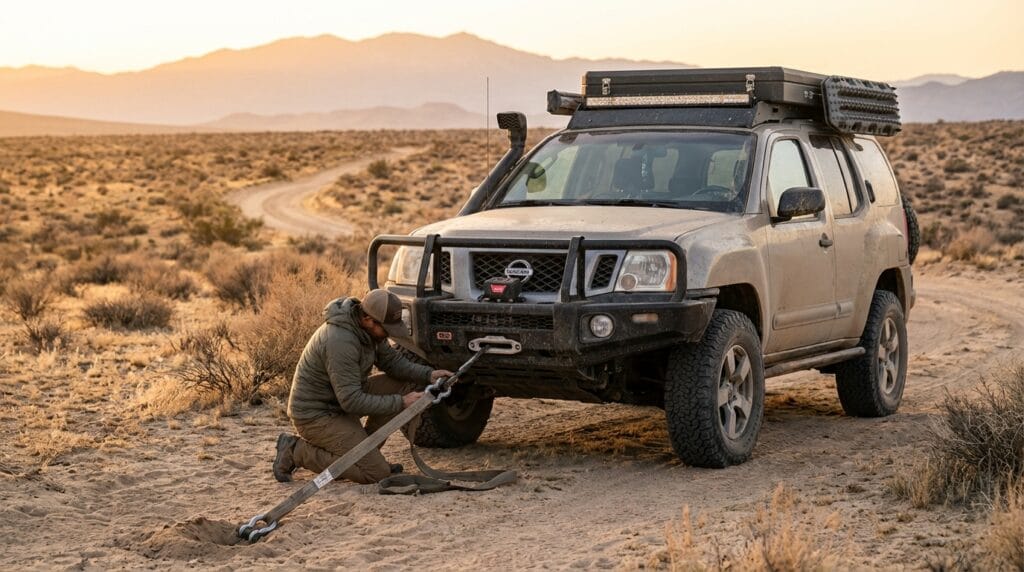
The “Deadman” Anchor: If you are in the desert with no trees, you may need to bury your spare tire or a dedicated land anchor. Burying a spare tire deep in the sand with a strap attached creates a substantial anchor point capable of withstanding the forces of a heavy off road recovery.
| Recovery Method | Effort Level | Required Gear | Best For |
|---|---|---|---|
| Airing Down | Low | Deflator, Compressor | Sand, deep snow, soft mud |
| Traction Boards | Medium | Boards, Shovel | Slippery mud, ice, loose sand |
| Winching (Solo) | High | Winch, Tree Saver, Dampener | Deep bogs, steep inclines |
| Hi-Lift Jacking | Very High | Hi-Lift Jack, Base Plate | High-centered obstacles, lifting wheel for rock stacking |
The Hi-Lift Jack: A Tool of Last Resort
For many off-roaders, the Hi-Lift jack is iconic, but it is also one of the most dangerous tools in your kit. In a solo scenario, it can be used to lift a wheel out of a hole so you can “stack rocks” underneath it to build a road. Alternatively, with the right chains and rigging, a Hi-Lift can function as a manual winch (come-along).
However, extreme caution is required. The handle carries a massive load and can cause serious injury if it snaps back. Ensure the jack has a stable base plate to prevent it from sinking into the soft ground you are trying to escape.
Winter 2026 Trail Conditions and Safety
Navigating the backcountry this winter requires extra preparation. With recent weather patterns shifting, trails that were passable last year may now have deep washouts or unexpected soft spots. When attempting a self-recovery in cold weather, remember that battery efficiency drops. If you are using an electric winch, keep your engine running to maintain charge, and take breaks to let the winch motor cool down—overheating your equipment is a surefire way to turn a temporary delay into an overnight stay.
Knowing When to Call the Pros
There is a fine line between a challenging adventure and a dangerous situation. If your vehicle is tilted at a precarious angle, if you are mechanically broken, or if you have exhausted your physical energy, it is time to stop. Pushing past your limits when solo can lead to injury or total vehicle loss.
Professional off road recovery services have specialized equipment, including rotators and extended-reach winches, that can extract vehicles from situations where self-recovery gear fails. Recognizing when you are beaten is a sign of an experienced driver, not a novice.
Whether you are stuck in a wash or high-centered on a rocky trail, your safety is the priority, and sometimes the smartest tool in your box is your phone. If your solo adventure has come to a halt, call us immediately at 480-725-5862 for rapid assistance. You can also request a professional winch-out online so we can get you back on the trail or back home safely.