As January 2026 brings unpredictable cold fronts and icy conditions to the roadways, ensuring your rig is prepared for the elements is critical for safety. By mastering these essential winter towing tips, you can confidently navigate slippery slopes and protect both your vehicle and your cargo from disaster.
Table of Contents
The Winter of 2026: Why Preparation Matters More Than Ever
This year, we are seeing a significant shift in weather patterns, with sudden freezes affecting routes that are typically mild. Whether you are hauling a trailer up north to Flagstaff or navigating slick city streets after a rare desert rain-freeze, the margin for error is slim. Modern trucks in 2026 come equipped with advanced stability control and trailer sway assist, but technology cannot entirely overcome the laws of physics on black ice.
Implementing solid winter towing tips begins before you even turn the key. It starts with a rigorous inspection of your equipment. Cold weather drops tire pressure and saps battery life faster than you might expect. Before hitching up, ensure your load is balanced correctly; an uneven load on an icy road is a jackknife waiting to happen.
Essential Vehicle Checks Before You Haul
Your pre-trip inspection needs to be thorough. Neglecting small maintenance issues can lead to major failures when temperatures drop.
- Tire Health: Check the tread depth and pressure on both the tow vehicle and the trailer. Cold air causes tire pressure to drop (roughly 1 PSI for every 10°F drop).
- Battery Power: Towing puts extra strain on your electrical system for lights and trailer brakes. Ensure your battery is fully charged and load-tested.
- Fluid Levels: Switch to a winter-grade wiper fluid that won’t freeze on your windshield, and check your antifreeze levels to prevent engine block cracking.
- Brake Systems: Test your trailer brake controller adjustments. You may need to reduce the gain slightly to prevent trailer wheels from locking up on slick surfaces.
Understanding Stopping Distances on Ice
One of the most vital winter towing tips to remember is that your stopping distance increases exponentially on snow or ice. When you add thousands of pounds of trailer weight, momentum becomes your enemy. Below is a comparison of estimated stopping distances to help you visualize the danger.
| Road Condition | Speed (MPH) | Standard Vehicle Stopping Distance | Towing Vehicle Stopping Distance |
|---|---|---|---|
| Dry Pavement | 60 | ~130 ft | ~200 ft |
| Wet/Rain | 60 | ~170 ft | ~280 ft |
| Snow/Packed Snow | 40 (Reduced) | ~250 ft | ~450 ft |
| Black Ice | 30 (Reduced) | ~500+ ft | ~900+ ft |
Driving Techniques for Slick Conditions
Once you are on the road, your driving style must adapt immediately. Aggressive driving is the leading cause of winter accidents.
The “Egg” Rule
Imagine there is a raw egg between your foot and the gas or brake pedal. Press too hard, and you break the egg. All inputs—steering, braking, and accelerating—must be gentle and deliberate. Sudden movements can break traction, causing your trailer to sway or slide sideways.
Handling Trailer Sway on Ice
If you feel your trailer starting to slide, your instinct might be to slam on the brakes. Do not do this. Slamming the brakes will likely cause the trailer to jackknife. Instead:
- Ease off the accelerator immediately.
- Keep your steering wheel straight or steer slightly into the slide if the vehicle is also sliding.
- Manually apply the trailer brakes lightly using your brake controller (if equipped) to pull the trailer back into line.
Your Winter Emergency Kit
Even with the best winter towing tips and preparation, things can go wrong. A sudden mechanical failure or an unexpected storm can leave you stranded. In 2026, while we rely heavily on cell phones, battery life drops rapidly in the cold, and reception can be spotty in mountain passes. Always carry a physical emergency kit.
Must-have items include:
- Heavy-duty jumper cables or a portable lithium jump starter.
- Sand, kitty litter, or traction mats for getting unstuck.
- Extra warm clothing, blankets, and gloves.
- High-calorie non-perishable food and water.
- Flares or reflective triangles to warn other drivers.
- A spare tire for the trailer (and the tools to change it).
When to Call the Professionals
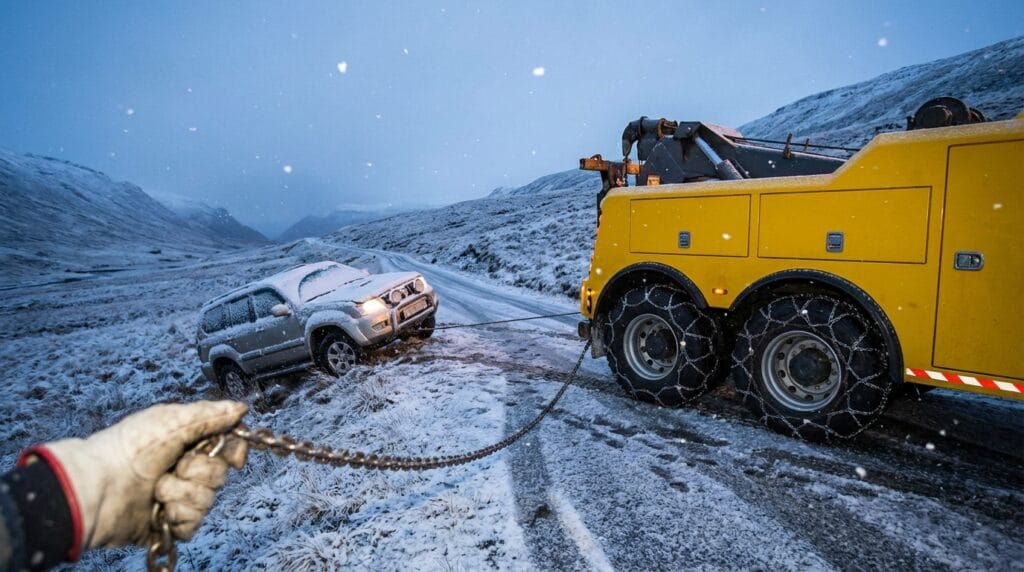
Sometimes, the smartest towing decision is knowing when not to tow. If visibility is near zero or the roads are coated in a sheet of ice, pull over safely. If you find yourself stuck in a ditch or facing a mechanical breakdown in freezing temperatures, do not risk your safety trying to fix it on the side of a highway. Professional towing services have the specialized equipment, such as flatbeds with winches and heavy-duty rotators, to recover vehicles safely without causing further damage.
Don’t let a winter breakdown leave you stranded in the cold; call the experts at Tow Mesa at 480-725-5862 for immediate, professional assistance. If you are planning a haul and want to ensure you have the right support lined up, get a free quote for winter transport services before you hit the road. Stay safe, drive smart, and let us handle the heavy lifting this season.