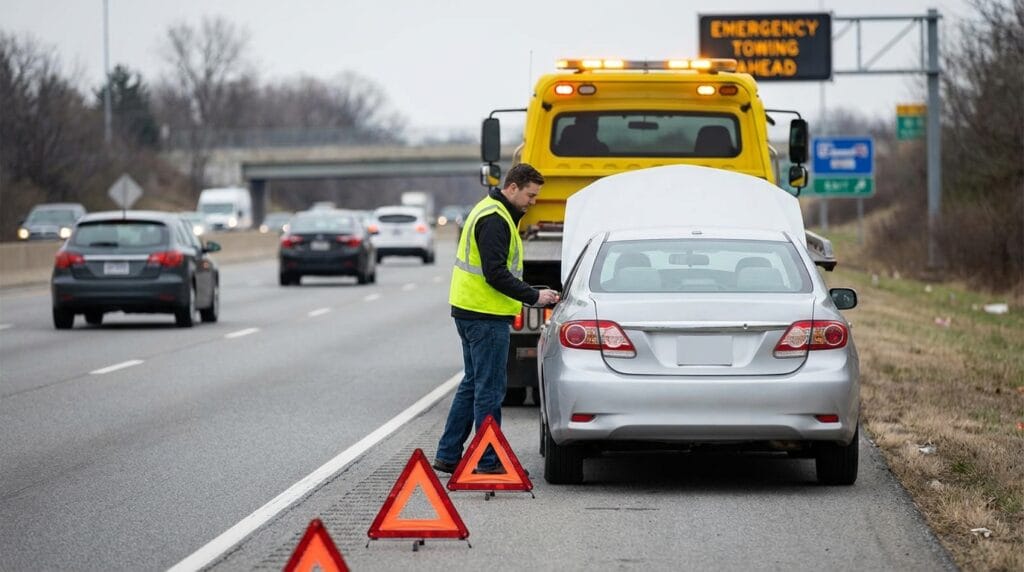
Breaking down on a busy highway is a driver’s worst nightmare, especially amidst the post-holiday traffic and chilly evening temperatures typical of late December. Knowing how to react quickly not only prevents secondary accidents but also ensures your safety while you wait for professional emergency towing to arrive on the scene.
Table of Contents
The First 60 Seconds: Immediate Safety Protocols
The moment you feel your vehicle losing power or handling poorly, the clock starts ticking. Panic is your enemy; protocol is your friend. In the high-speed environment of a Mesa highway, your primary goal is to separate yourself from the flow of traffic.
Follow these immediate steps to secure your vehicle:
- Signal and Decelerate: Put on your turn signal immediately. Do not slam on the brakes; instead, lift your foot off the accelerator and let the car coast while guiding it toward the right shoulder.
- Aim for the Right Shoulder: The left shoulder is often narrower and places you closer to the fast lane (“the hammer lane”), which is significantly more dangerous. Always aim for the right shoulder if possible.
- Activate Hazard Lights: As soon as you realize there is an issue, turn on your hazard lights (flashers). This alerts other drivers that you are moving significantly slower than the speed limit.
- Park and Turn Wheels: Once stopped, turn your steering wheel away from the road. If your car is struck from behind, this angle helps prevent the vehicle from being pushed into active traffic.
Visibility is Survival: Winter 2025 Considerations
As we approach the end of 2025, modern vehicles are quieter and faster, but visibility remains a challenge, particularly during the longer nights of December. If your breakdown occurs at night or during a winter rainstorm, being seen is synonymous with being safe.
While waiting for your emergency towing provider, you must maximize your vehicle’s footprint. If you have safety triangles or road flares in your emergency kit, deploy them only if it is safe to exit the vehicle. Place the first flare 10 feet behind the car, the second 100 feet back, and the third 300 feet back. This graduated warning gives approaching drivers time to change lanes.
To Exit or Not to Exit?
This is the most common question drivers ask. The general rule of thumb for highway breakdowns is: Stay Inside.
Unless your vehicle is on fire or there is a distinct smell of gasoline, your car offers the best protection against moving traffic. Lock the doors, keep your seatbelt fastened, and stay off your phone except to call for help. If you absolutely must exit the vehicle (for example, to change a tire on the non-traffic side), never turn your back on oncoming cars.
Communicating with Your Towing Dispatcher
When you call Tow Mesa, the efficiency of our response depends heavily on the accuracy of the information you provide. Highway locations can be ambiguous. To facilitate rapid emergency towing services, try to pinpoint your location using mile markers rather than vague landmarks.
| Information Category | Details to Provide | Why It Matters |
|---|---|---|
| Exact Location | Mile markers, nearest exit number, direction of travel (North/South/East/West). | Ensures the tow truck doesn’t have to drive miles past you to turn around. |
| Vehicle Condition | Flat tire, engine smoke, transmission failure, stuck in mud/ditch. | Determines if a flatbed or wheel-lift truck is required. |
| Passenger Count | Number of adults, children, and pets. | Ensures the tow operator can legally and safely transport all passengers. |
Managing the Wait: Cold Weather Tips
Since it is late December, temperatures in Mesa can drop quickly once the sun sets. While waiting for assistance, you need to manage your vehicle’s resources. If your engine is operable, run it for 10 minutes every hour to generate heat, but ensure your exhaust pipe is clear of mud or debris to prevent carbon monoxide poisoning.
Preserve your phone battery. After you have contacted Tow Mesa and family members, close unnecessary apps and lower your screen brightness. You need that battery line open in case the driver needs to call you for final location confirmation.
Why DIY Repairs on the Highway are Dangerous
In the era of YouTube tutorials, many drivers feel empowered to fix minor issues themselves. However, a highway shoulder is not a garage. The wind draft from passing semi-trucks can shake your vehicle enough to knock it off a jack, and distracted drivers may drift into the shoulder without warning.
Even for a simple flat tire, if the flat is on the driver’s side (facing traffic), do not attempt to change it. The risk is simply too high. Professional emergency towing operators are trained to create safe workspaces using their heavy trucks as barriers. They wear high-visibility gear and utilize extensive lighting systems that a standard passenger car lacks. Prioritize your life over the convenience of a quick fix.
The “Move Over” Law
While you wait, you might notice cars moving over to the next lane as they pass you. Arizona’s “Move Over” law requires drivers to shift lanes or slow down significantly when passing a vehicle with flashing lights on the shoulder. This law exists to protect you and the first responders helping you. By keeping your hazard lights on, you are legally triggering this safety requirement for other drivers.
Your Proactive Approach for 2026
As we head into the New Year, take a moment to review your vehicle’s emergency readiness. Do you have a portable battery jumper? Is your spare tire inflated? Breakdowns are often unexpected, but they don’t have to be catastrophic. By staying calm, maximizing visibility, and calling for professional help immediately, you handle the situation like a pro.
Don’t let a breakdown leave you stranded in the cold this holiday season; trust Tow Mesa to get you and your vehicle to safety efficiently. If you need immediate assistance, call our dispatch team right now at 480-725-5862. For non-urgent inquiries or to prepare for future road trips, you can request a priority service quote online.