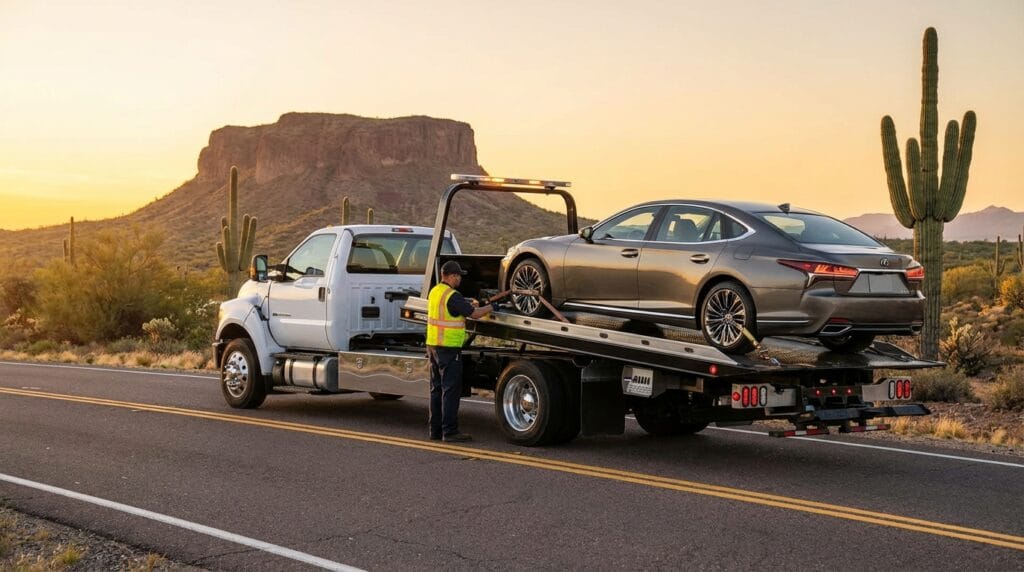
Breakdowns involving semi-trucks or construction equipment on the US 60 or Loop 202 demand immediate, specialized intervention rather than a standard tow truck. Every minute your fleet vehicle sits idle on the shoulder creates a cascade of lost revenue and safety liabilities for your operation. We deploy industrial-grade rotators and heavy wreckers specifically engineered to manage gross vehicle weights exceeding 26,000 pounds under the intense Arizona heat.
Table of Contents
Heavy Duty Towing Defined by Weight and Equipment
Heavy duty towing is not merely a larger version of standard car towing; it is a distinct industrial discipline governed by strict federal and state regulations. Specifically, this service category targets vehicles with a Gross Vehicle Weight Rating (GVWR) of 26,001 pounds or more. This classification, often referred to as Class 8 in the trucking industry, includes tractor-trailers, dump trucks, cement mixers, and motor coaches.
The distinction lies in the recovery equipment required. While a standard flatbed relies on a simple winch and hydraulic bed, heavy duty towing utilizes integrated wreckers and rotators. A rotator is a crane-like apparatus capable of rotating 360 degrees, allowing operators to lift and recover overturned heavy equipment from ditches or embankments without blocking multiple lanes of traffic. This capability is critical in Mesa, where maintaining traffic flow on arterials like Country Club Drive or Gilbert Road is a priority for local law enforcement [1].
For fleet managers and owner-operators, understanding this definition prevents the dangerous mistake of dispatching an underpowered tow truck. A standard wrecker attempting to tow a fully loaded semi-truck risks catastrophic mechanical failure, cable snapping, and severe liability issues. Real heavy duty service involves calculating the resistance to overturn and the working load limit of every chain and strap used during the recovery.
Technical Specifications and Local Data Analysis
Executing a safe heavy recovery in the East Valley requires analyzing load distribution, axle weight, and environmental conditions. The asphalt temperature in Mesa can exceed 160°F during summer, which alters the friction coefficient of tires and affects how stabilizing legs on recovery trucks interact with the pavement. We adjust our rigging strategies to account for soft asphalt to prevent sinking and further damage.
- Axle Weight Distribution: Arizona law dictates strict weight limits per axle group. When towing a disabled semi, the tow truck must lift the front or rear axle, effectively transferring that weight onto the tow truck’s chassis. We calculate this transfer to ensure the combined unit remains legal and safe to cross bridges and overpasses.
- Braking Capacity: A heavy duty wrecker must possess sufficient braking force to stop both itself and the towed load. This is why our units are equipped with reinforced air brake systems that integrate with the towed vehicle’s brakes, ensuring synchronized stopping power on off-ramps like those on the Superstition Freeway.
- Boom Rating vs. Static Load: A 50-ton rotator does not mean it can lift 50 tons at full extension. The capacity decreases as the boom extends away from the truck’s center of gravity. Expert operators use load charts to determine exactly how far they can reach to recover a vehicle without tipping the wrecker.
- Arizona “Move Over” Law Compliance: Recovery operations on high-speed corridors like the Loop 101 require strict adherence to ARS 28-775, which mandates that passing traffic vacate the lane adjacent to emergency vehicles. We position our heavy wreckers to create a physical buffer zone, protecting our operators and your vehicle during the hook-up process [2].
Towing Classifications and Equipment Requirements
The following table breaks down the specific equipment required based on vehicle weight classes, helping you identify exactly what resource your situation demands.
| Vehicle Class | GVWR Range (lbs) | Common Examples | Required Tow Equipment |
|---|---|---|---|
| Light Duty | 0 – 10,000 | Sedans, Pickups, SUVs | Flatbed or Wheel-Lift |
| Medium Duty | 10,001 – 26,000 | Box Trucks, RVs, Delivery Vans | Medium Wrecker (Low Profile) |
| Heavy Duty | 26,001 – 33,000 | City Buses, Single Axle Tractors | Integrated Wrecker (25-Ton) |
| Super Heavy Duty | 33,001+ | Loaded Semis, Cranes, Fire Trucks | Rotator (50-75 Ton) |
Protocol for Heavy Duty Incidents
When a heavy vehicle fails, the actions taken in the first fifteen minutes dictate the speed and cost of the resolution. Panic often leads to improper securing of the scene or calling the wrong service provider, which delays recovery and increases the risk of secondary accidents.
- Secure the Immediate Perimeter: Before inspecting the mechanical failure, deploy safety triangles or flares. Federal regulations require placement at 10 feet, 100 feet, and 200 feet behind the vehicle on the traffic side. On curved ramps like the US 60 to I-10 interchange, these distances must be adjusted to give oncoming traffic adequate warning.
- Verify the Load Status: You must communicate whether you are loaded or empty. A loaded trailer adds significantly to the gross weight and changes the towing requirements. If you are hauling hazardous materials, this information must be relayed immediately, as it triggers specific environmental safety protocols and may require a HazMat certified recovery team.
- Identify Driveline Specs: To prevent transmission damage, we need to know if the driveshaft needs to be disconnected. For modern automated manual transmissions, specific procedures are required to put the vehicle in neutral if the engine will not start. Providing this info upfront allows our experienced team to arrive with the correct tools in hand.
- Check Clearance Heights: If your vehicle is stuck under an overpass or in a parking structure, exact clearance measurements are vital. We utilize low-profile heavy wreckers for height-restricted areas, but we must know the constraints before dispatch.
- Photo Documentation: Take photos of the position of the truck and the surrounding terrain. If the truck is off the road, the degree of the slope and the type of soil (sand, mud, gravel) will determine if we need a winch-out or a crane lift. This visual data helps us deploy the correct number of assets.
Complexity in Recovery Operations
Many fleet managers assume that heavy duty towing is a commodity based solely on price per mile. This perspective ignores the nuance of recovery engineering. A “cheap” tow that damages the oil pan, shears a differential, or twists a frame rail due to improper rigging ends up costing thousands more in repairs than a properly executed professional recovery.
Insurance coverage for heavy duty recovery is often misunderstood. Standard roadside assistance policies rarely cover the full cost of a complex rotator recovery involving cargo transfer. You need to understand the difference between “consent towing” (you call us) and “non-consent towing” (police call us). In non-consent scenarios, rates are often regulated, but in consent scenarios, the quality of the operator is your primary variable [3].
Another critical nuance is the handling of cargo. If a trailer has compromised structural integrity, simply dragging it onto a wrecker can cause it to split open. We employ air cushion recovery systems to upright overturned trailers without unloading them, preserving the cargo and saving hours of labor. This technique uses low-pressure airbags to gently lift the unit, a method that requires specialized certification and equipment not found on standard tow trucks.
Furthermore, the geography of Mesa presents unique challenges. The expansive construction zones along the Broadway Curve project mean limited shoulders and tight maneuvering spaces. Operators must be skilled in backing huge rigs into tight closures without disrupting construction progress. Our drivers are trained specifically for these high-stress environments where precision is mandatory.
Technological Evolution in Heavy Recovery
The heavy duty towing industry is undergoing a significant shift due to the electrification of commercial fleets. Electric semi-trucks, like the Tesla Semi or Freightliner eCascadia, introduce new variables: extreme battery weight and high-voltage risks. Towing an electric heavy truck requires distinct protocols to avoid thermal runaway in the battery packs or regenerating power into a dead system, which can fry the electronics.
We are also seeing a rise in telematics integration. Modern recovery trucks are equipped with real-time diagnostics that can interface with your fleet management software. This allows for seamless data transfer regarding the vehicle’s location, fault codes, and status, reducing the administrative burden on your dispatch team. The future of heavy towing is not just about raw power; it is about data integration and specialized handling of alternative fuel vehicles [4].
Additionally, advanced composite materials used in newer tractor cabs require different hook-up points. Traditional chain-down methods can crack fiberglass hoods or fairings. We utilize wheel-grid lifting systems that grab the tires rather than the frame or body, eliminating contact damage to the exterior of your aerodynamic fleet vehicles.
Secure Your Fleet with Mesa’s Heavy Duty Experts
When a heavy-duty asset goes down, you need a partner who understands the weight, the regulations, and the urgency of the situation. We provide more than just a tow; we provide a logistical solution to get your equipment back on the road or to the shop without incurring secondary damage. Our fleet is positioned to respond rapidly to any location in the Mesa area, from downtown to the outer reaches of the East Valley.
Don’t leave your most valuable assets in the hands of inexperienced operators. We have the rotators, the certifications, and the local knowledge to handle the toughest recoveries safely.
Contact us immediately for heavy duty support:
- 24/7 Dispatch Line: 480-725-5862
- Request Service Online: Dispatch a heavy duty wrecker in Mesa now
For more information on our full range of capabilities, visit our pages on vehicle towing services or read about our specific roadside assistance protocols.
Sources
- FMCSA Regulations on Coupling Devices and Towing Methods – Federal Motor Carrier Safety Administration
- Move Over AZ Law Explanation – Arizona Department of Transportation
- Towing & Recovery Incentive Program (TRIP) Standards – TRAA
- Commercial Vehicle Safety Research – NHTSA
- Traffic Incident Management in Construction Zones – Federal Highway Administration