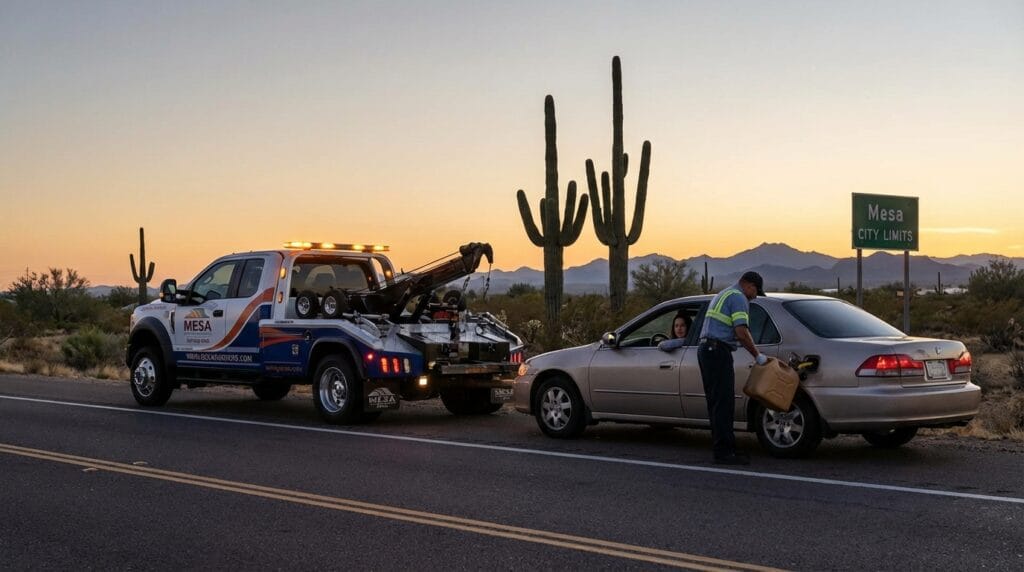
Your dashboard estimated twenty miles of range remaining, but stop-and-go congestion on the Superstition Freeway drained that buffer faster than the algorithm predicted. When the engine sputters and dies, you need immediate fuel delivery to prevent mechanical damage and dangerous highway exposure.
Table of Contents
Defining Emergency Fuel Delivery in Mesa
In the sprawling geography of the East Valley, running out of fuel is a logistical nightmare and a mechanical hazard. Mesa covers over 133 square miles, ranging from the dense urban grid of downtown to the remote stretches near Usery Mountain. Emergency fuel delivery is not merely about bringing a gas can to a stranded driver; it is a rapid-response service designed to mitigate safety risks and restore vehicle function without requiring a tow.
We provide on-site delivery of regular unleaded, premium, or diesel fuel directly to your location. This service bridges the gap between a stalled engine and the nearest service station. For diesel vehicles, this often involves more than just pouring in fuel; it may require priming the system to remove air locks that occur when the tank runs completely dry. Our technicians operate throughout Mesa, navigating the complex interchanges of the Loop 202 and US 60 to reach stranded motorists before heat exposure or traffic hazards escalate the situation.
Mechanical Risks of Running on Fumes
Drivers often treat the “E” on their fuel gauge as a suggestion rather than a warning. This behavior, often called “testing the reserve,” causes significant long-term damage to modern vehicles.
The Fuel Pump Cooling Factor
In the vast majority of vehicles manufactured after 2000, the fuel pump is located inside the gas tank. It relies on the gasoline itself for lubrication and cooling. When you operate a vehicle with less than a quarter tank, the pump is exposed to air, causing it to run hotter. When you run completely dry, the pump spins at high RPMs without resistance or lubrication, leading to immediate overheating. Repeatedly running low causes premature failure, a repair that costs between $800 and $1,200 for most sedans in 2026.
Sediment and Injector Clogging
Fuel tanks accumulate sediment, rust, and debris over time. These heavy particles settle at the bottom of the tank. When fuel levels drop critically low, the pump draws from this bottom layer, sucking concentrated debris into the intake filter. If these particles bypass the initial filter, they clog fuel injectors, disrupting the spray pattern required for efficient combustion. This results in rough idling, poor acceleration, and decreased fuel economy long after the tank is refilled.
Cost Analysis: Delivery vs. Repair
Ignoring the low fuel light is expensive. The table below outlines the financial reality of pushing your luck versus calling for assistance.
| Expense Category | Estimated Cost (2026) | Time Impact |
|---|---|---|
| Emergency Fuel Delivery | Service Call Fee + Fuel Cost | 30–45 Minutes |
| Fuel Pump Replacement | $880 – $1,450 | 2–3 Days in Shop |
| Fuel Injector Cleaning | $250 – $400 | 1 Day |
| Catalytic Converter Damage | $1,500 – $3,000 | 2–5 Days |
| Towing (if pump fails) | $125 – $300 | 1–2 Hours |
Protocol for Highway Safety
Running out of gas on a high-speed corridor like the Loop 202 Red Mountain Freeway places you in immediate danger. Arizona Department of Public Safety (AZDPS) data indicates that secondary collisions—vehicles striking a stranded car—are a leading cause of highway fatalities [1].
Immediate Maneuvers
- Preserve Momentum: As soon as the engine hesitates, shift to neutral (if safe) to coast further. Do not brake abruptly.
- Target the Right Shoulder: The left median is a “kill zone.” Drivers in the fast lane are less likely to expect a stopped vehicle. Aim for the right shoulder where there is typically more clearance.
- Wheel Orientation: Once stopped, turn your steering wheel away from the road. If your car is struck from behind, this angle directs the vehicle into the dirt or barrier rather than into active traffic.
- Stay Inside: Unless your vehicle is on fire or in a precarious position (like a blind curve), remain buckled inside. The vehicle’s frame offers far more protection than standing on the roadside.
The Diesel Distinction
Diesel engines present unique challenges when run dry. Unlike gasoline engines, which usually restart immediately after refueling, a diesel fuel system relies on high pressure. When air enters the lines, the injectors cannot pressurize the fuel. This requires “bleeding” the system. Our roadside assistance teams carry the necessary tools to prime diesel systems, ensuring heavy-duty trucks and diesel passenger cars can restart without draining the battery.
The Psychology of Range Anxiety
“Range anxiety” is no longer exclusive to electric vehicle owners. Modern digital dashboards often display a “Distance to Empty” (DTE) metric. Drivers mistakenly interpret this as a precise measurement. In reality, the DTE is an algorithm based on past driving conditions.
If you spent the last 100 miles driving efficiently on a flat highway, the computer assumes that efficiency will continue. Once you hit Mesa city traffic on Stapley Drive or tackle an incline, fuel consumption spikes, and the predicted 20 miles of range can vanish in 5 actual miles. Trusting the gauge over the physical needle is the primary cause of fuel-related strandings we encounter.
Counter-Arguments: Why Not Walk?
A common reaction to running out of gas is the urge to walk to the nearest station. In Mesa, this is frequently a dangerous miscalculation.
Pedestrian Risks
Mesa’s arterial roads are wide, with speed limits often exceeding 45 mph. Sidewalks may be intermittent in industrial areas or near highway ramps. Walking along the shoulder of the US 60 is illegal and potentially fatal. In 2024, Arizona ranked among the highest states for pedestrian fatalities, with many incidents occurring outside of crosswalks on high-speed roads [2].
Container Compliance
Gas stations are legally prohibited from dispensing fuel into unapproved containers. Using a water bottle, milk jug, or coffee cup is not only a fire hazard but will be refused by station attendants. You must purchase a certified gas can, which adds $15–$25 to your costs, assuming the station has them in stock.
The “Jerry Can” Myth
Some drivers keep a gas can in their trunk “just in case.” This is ill-advised. Gasoline degrades over time; fuel stored for more than six months loses combustibility and can gum up your engine. Furthermore, fluctuating Arizona temperatures cause plastic cans to expand and contract, releasing benzene fumes into the vehicle cabin. Professional fuel delivery ensures fresh, high-octane fuel is provided without the safety risks of long-term storage.
Seasonal Fuel Efficiency in Arizona
The time of year significantly impacts how far a tank of gas gets you in Mesa.
Summer Evaporation and AC Load
In July and August, temperatures on the tarmac exceed 140°F. Gasoline is volatile and evaporates faster in these conditions. While modern closed fuel systems mitigate this, older gas caps with worn seals allow fuel to vaporize into the atmosphere. Additionally, running the AC at max power increases fuel consumption by up to 20%. A quarter tank in January lasts longer than a quarter tank in July.
Winter Density
January brings cooler, denser air. While this theoretically improves engine power, winter fuel blends often contain additives to prevent freezing (less relevant in Mesa, but standard in distribution). However, cold starts require a richer fuel mixture, meaning your engine consumes more gas in the first 5 minutes of operation than when it is warm. Short trips around town in January will drain a tank faster than highway driving.
2026 Trends in Mobile Energy
The concept of “fuel delivery” is evolving. We are observing a shift in how energy is distributed to stranded vehicles.
Mobile EV Charging
While liquid fuel remains the dominant need, the rise of electric vehicles in the East Valley has introduced “mobile charging” as a parallel service. Specialized trucks equipped with Level 3 fast chargers can now provide a 10-mile range boost to dead EVs in 15 minutes. While distinct from traditional gasoline delivery, the logistics are identical: bringing energy to the roadside to prevent a tow.
On-Demand Fueling Apps
New platforms are attempting to “Uber-ize” gas delivery, allowing users to order a fill-up while parked at work. However, for emergency roadside scenarios, these app-based services often lack the clearance, safety lighting, and training required to operate on active highways. Tow Mesa prioritizes emergency response, ensuring our trucks are equipped to protect the scene while dispensing fuel.
Navigating Mesa’s Road Network
Understanding where you are stranded helps us reach you faster. Mesa’s grid system is consistent, but geographical barriers like the Salt River and the canals create choke points.
- Downtown Mesa: Narrow streets and one-way grids require precise navigation.
- Loop 202 (Red Mountain): Limited access points mean if you are stranded between exits, our drivers must calculate the correct upstream entry to reach you safely.
- Eastmark and South Mesa: Rapid construction in these areas often means GPS maps are outdated. Our local drivers know the new thoroughfares that aren’t on the satellite yet.
The Legal and Insurance Perspective
Leaving a vehicle on the side of a Mesa highway for an extended period risks impoundment. AZDPS can tag and tow an abandoned vehicle within hours if it impedes traffic. By calling for delivery immediately, you demonstrate active management of the situation.
Regarding cost, many insurance policies include roadside assistance. However, calling your insurer’s 1-800 number often routes you to a national dispatch center that acts as a middleman, delaying service by 45–90 minutes. Calling a local provider directly cuts out the middleman. We can provide itemized receipts for you to submit for reimbursement, getting you back on the road hours sooner than the “free” option provided by insurance aggregators.
Comprehensive Roadside Support
Fuel delivery is rarely an isolated event. Often, a driver runs out of gas because they were distracted by another mechanical issue, or the battery dies while they sit on the shoulder waiting for help with the hazard lights on.
Battery Drain
If you run out of gas at night, you must leave your lights on for safety. A standard car battery has a reserve capacity of roughly 90–120 minutes with headlights on before it lacks the voltage to crank the engine. Once we deliver the fuel, we often perform a jump start to get the alternator spinning again.
Lockouts
Panic leads to mistakes. We frequently encounter drivers who stepped out of their stalled vehicle to check the traffic, leaving the keys in the ignition, and the automatic locks engaged. Our team is equipped to handle lockout assistance concurrently with fuel delivery, solving two problems in a single visit.
Protecting Your Engine Long-Term
To avoid the need for emergency delivery, adopt the “Quarter Tank Rule.” Treat the ¼ mark on your gauge as Empty. This keeps the fuel pump submerged and cool, prevents sediment intake, and provides a safety buffer for unexpected traffic delays on the US 60.
If you drive a high-mileage vehicle, consider using a fuel system cleaner periodically to dissolve gum and varnish that accumulates from running low on gas. However, no additive can fix a scorched fuel pump. Prevention is the only cure.
Immediate Action Plan
If your engine cuts out in Mesa:
- Signal and Coast: Move to the right shoulder immediately.
- Assess Location: Note the nearest mile marker or cross street (e.g., “US 60 eastbound, just past Gilbert Road”).
- Secure the Scene: Hazard lights on. Stay in the vehicle.
- Call for Fuel: Do not rely on walking or calling a friend who might take an hour.
We treat fuel delivery as a priority dispatch. The desert heat and highway speeds make every minute on the roadside a risk. We bring the right fuel, the right tools, and the safety protocols necessary to get you moving again.
Don’t risk your fuel pump or your safety by walking down a highway off-ramp. If you are empty, stay put and let us bring the station to you.
Call Tow Mesa for rapid fuel delivery anywhere in the East Valley. Visit Tow Mesa Contact to pin your location for our dispatch team.