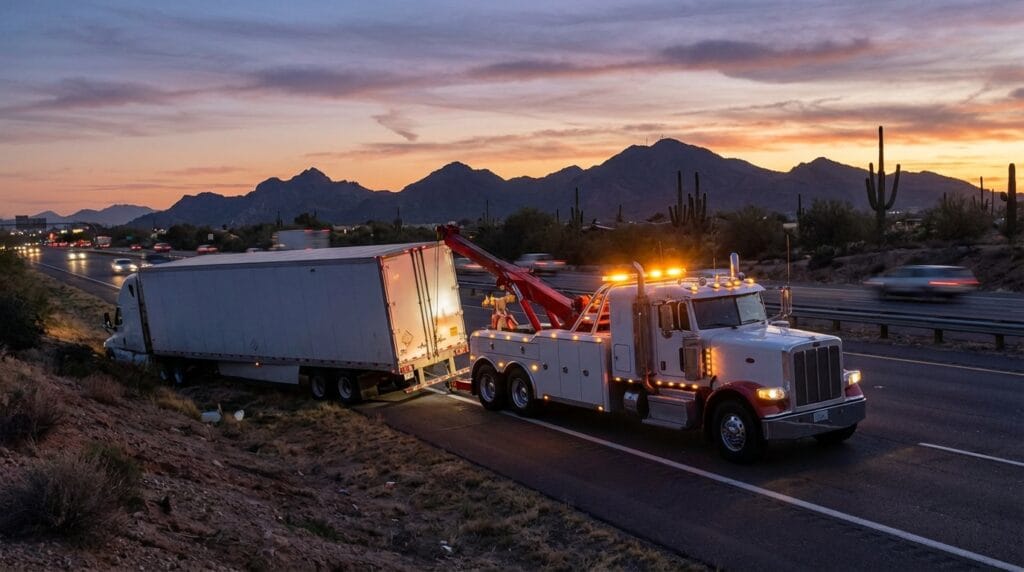
Accident recovery in Mesa is no longer just about moving a wrecked car; it is a high-stakes operation requiring precision to prevent secondary collisions on our expanding high-speed corridors. At Tow Mesa, we don’t just clear the road—we execute a tactical recovery strategy designed to protect you, your vehicle’s remaining value, and the safety of every driver on the Loop 202.
Table of Contents
Key Concept & Definition: What is Accident Recovery?
Accident recovery is a specialized service distinct from standard roadside towing. While a standard tow involves transporting a vehicle with a mechanical failure (like a dead battery or alternator), recovery involves extracting vehicles from compromised positions—rollovers, ditch excursions, embankment slides, or multi-car pileups.
In Mesa, this definition carries legal and technical weight. Under Arizona regulations, recovery operations often require:
- Scene Remediation: Cleanup of hazardous fluids (oil, coolant, transmission fluid) to prevent environmental fines and slick road surfaces.
- Complex Rigging: Using snatch blocks, winches, and rotators to upright a vehicle without causing further frame damage.
- Traffic Incident Management (TIM): Coordinating with Mesa Police Department (MPD) and DPS to shut down lanes and create a safe “work zone” to prevent secondary crashes.
The Mesa Reality: A breakdown on a quiet residential street in Alta Mesa requires a tow. A rollover on the US 60 near Country Club Drive requires recovery.
Deep Dive into Strategy & Data: The High Stakes of Mesa Roads
The landscape of driving in Mesa has shifted dramatically in late 2024 and heading into 2025. Our local data, cross-referenced with city safety reports, highlights a growing need for specialized recovery due to increased traffic density and speed.
High-Risk Intersections & Corridors (2025 Data)
Recent analysis identifies specific “hot zones” where recovery expertise is most frequently demanded:
| Location | Primary Risk Factor | Recovery Complexity |
|---|---|---|
| Dobson Rd & University Dr | High-volume intersection with complex turning lanes. | Medium: Traffic control is critical to avoid gridlock during extraction. |
| Loop 202 (Red Mountain) | High speeds (65+ mph) and curved ramps. | High: Rollovers common; requires rapid lane clearance to prevent secondary pileups. |
| US 60 (Superstition Fwy) | Heavy commuter traffic + ongoing construction zones. | Severe: Tight shoulders leave zero margin for error; secondary crash risk is extreme. |
| 8th Ave & Alma School Rd | Pedestrian/Vehicle conflict zones. | High: Sensitive scenes often involving police investigations and evidence preservation. |
The “Secondary Accident” Threat
A secondary accident is a crash that occurs as a direct result of an initial incident. Research indicates that for every minute a primary accident remains on a freeway lane, the risk of a secondary crash increases by 2.8% [1]. On the Loop 202 during rush hour, a 20-minute delay in recovery can statistically increase the collision risk by over 50%. This is why we prioritize Rapid Clearance protocols aligned with Arizona DPS goals.
Actionable Steps & Methodology: If You Crash, Do This
Panic is the enemy of safety. If you are involved in a collision in Mesa, follow this precise methodology to ensure a safe recovery process.
- Assess and Secure (The “Move Over” Rule)
- If the vehicle is drivable and there are no serious injuries, move to the nearest shoulder immediately. Arizona law (ARS 28-674) requires drivers to remove vehicles from the main traveled portion of the roadway if safe to do so.
- If you cannot move, stay buckled inside. Standing on the shoulder of the US 60 is statistically one of the most dangerous places in Arizona.
- Call 911, Then Call Us Directly
- Police dispatch will rotate a tow truck if you don’t have a preference, but you have the legal right to request a specific company.
- Tell the dispatcher: “I am requesting Tow Mesa for accident recovery.”
- Direct Line: 480-725-5862.
- Document for Insurance (Safely)
- Do not walk into traffic to take photos.
- Take wide shots showing the vehicle’s position relative to the road lines.
- Take close-ups of the damage and any debris field.
- Pro Tip: Photograph the other driver’s license plate immediately.
- Preserve the Chain of Custody
- Do not let a “chaser” (unsolicited tow truck) hook up your car. Predatory towers often monitor police scanners and arrive before called.
- Verify the truck branding matches who you called.
- Ask the driver for a printed invoice detailing the “Hook-up Fee” and “Price per Mile” before they lift your vehicle.
Nuance, Counter-arguments & Expert Opinions
“Why is recovery so much more expensive than a tow?” This is the most common friction point. A standard tow is a flat rate because the variables are controlled. Recovery is billed based on time, equipment, and risk.
- The Counter-Argument: Some insurers argue that a winch-out should be a flat fee.
- Our Expert View: A winch-out from a flat dirt lot is simple. A winch-out from a canal bank off McKellips Road involves rigging to prevent the car from rolling into the water, requiring two operators and a rotator boom. The liability and skill level are exponentially higher. “You aren’t paying for the hook; you’re paying for the 10 years of experience that ensures your axle doesn’t get ripped off during the pull,” says our Lead Recovery Operator.
The Insurance Gap Many “Roadside Assistance” add-ons cover towing (transport) but cap recovery (extraction) at $100. A complex rollover recovery on the highway can cost $600+.
- Nuance: Comprehensive collision coverage usually covers the full recovery bill, whereas “emergency road service” riders often do not. Always clarify with your adjuster if the bill is categorized under “Collision Claims” or “Roadside Service.”
Future Outlook & Trends: Mesa’s Safety Action Plan
Mesa is aggressively implementing its Comprehensive Safety Action Plan, aiming for a 30% reduction in fatalities by 2030. What does this mean for towing?
- Smarter Infrastructure: Projects like the Extension Road redesign are creating dedicated spaces for bikes and pedestrians, which changes how we access accident scenes. Recovery trucks will need to navigate narrower, protected lanes.
- Tech-Integrated Recovery: We are moving toward digital integration with the City’s Traffic Management Center (TMC). In the future, recovery trucks will receive real-time signal priority to reach scenes faster, reducing the “secondary accident” window.
- EV Recovery Protocols: With the rise of EVs in the East Valley, recovery now involves thermal monitoring. Damaged EV batteries pose a fire risk long after the crash. We are training our teams on isolation protocols—storing crashed EVs in designated “quarantine zones” at our yard to prevent yard fires [2].
Conclusion: Don’t Leave Your Safety to Chance
In the chaos of a collision, the company you choose determines whether your bad day gets resolved or compounded. Accident recovery in Mesa demands local knowledge, heavy-duty capability, and a safety-first mindset.
We know the difference between a simple tow and a complex extraction. We know the Loop 202 ramps, the US 60 bottlenecks, and the desert terrain. When the unexpected happens, assert your right to choose a professional.
Ready for professional support?
- Immediate Dispatch: 480-725-5862
- Request Service Online: Contact Us
- Learn More: About Our Team