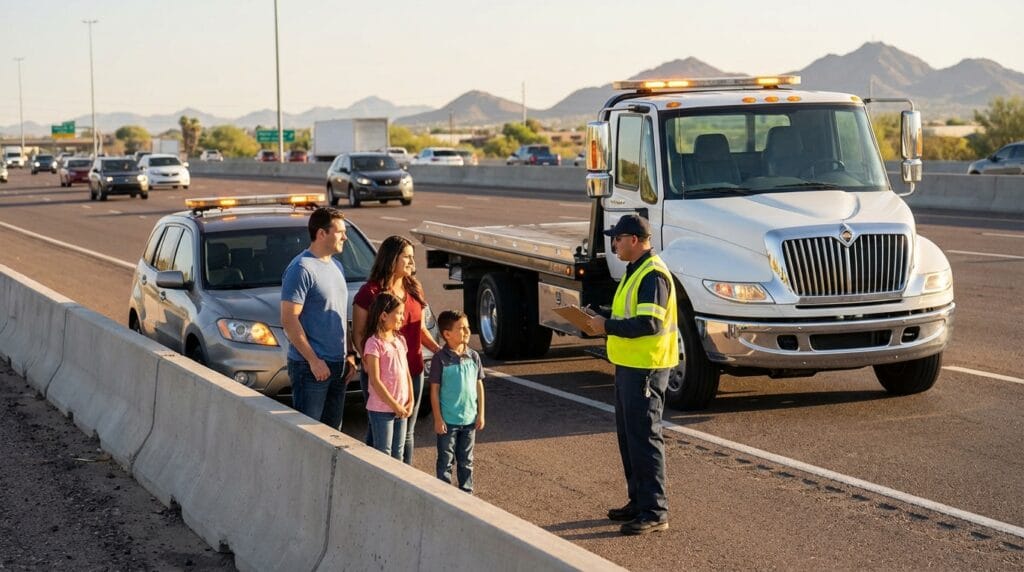
How to Stay Safe and Sane While Waiting for Roadside Assistance on a Busy Highway
Breaking down in the middle of a Mesa commute on the US-60 or Loop 202 is a high-stress event that requires immediate action to protect yourself and your passengers. By following professional protocols and calling for reliable roadside assistance, you can turn a potentially dangerous situation into a manageable inconvenience.
Key Takeaways for Highway Emergencies
- Prioritize the Right Shoulder: Always aim for the right side of the road, as the left shoulder is significantly more dangerous.
- Stay Inside Your Vehicle: In most highway scenarios, the metal frame of your car is your best protection against high-speed traffic.
- Visibility is Life: Use hazard lights, flares, or reflective triangles to ensure other drivers see you from a distance.
- Stay Calm and Professional: Having a clear plan and a trusted partner like Tow Mesa reduces anxiety during the wait.
Table of Contents
Immediate Safety Measures: The First Five Minutes
The moments immediately following a mechanical failure are the most critical. If your engine dies or a tire blows, your primary goal is to move the vehicle out of the flow of traffic. According to the Strategic Highway Safety Plan (SHSP) with appendices, secondary crashes—accidents that occur as a result of an existing incident—are a significant risk on high-speed corridors. We’ve found that drivers who manage to reach the far-right shoulder or, better yet, an exit ramp, experience far fewer “close calls” with passing motorists.
Once you have stopped, turn your wheels away from the road and engage the emergency brake. This ensures that if your vehicle is struck from behind, it is pushed into the ditch or toward the wall rather than back into live traffic. Turn on your hazard lights immediately. If it is after dark—which happens early during these late January days—keep your interior dome light on so you are visible to roadside assistance professionals and other drivers alike.
“The safest place for a stranded motorist on a busy highway is buckled into their seat inside the vehicle, unless the vehicle is on fire or there is a risk of being submerged.”
Staying Sane: Managing the Wait in January Weather
In Mesa, January 2026 has brought us some crisp mornings and chilly evenings. Waiting for a tow truck can take anywhere from twenty minutes to an hour depending on traffic density and your location. To stay sane, you must manage your environment. If your heater is still functional, use it sparingly to avoid draining the battery, but prioritize staying warm. Our clients often find that keeping a small “emergency kit” with water, snacks, and a portable phone charger makes the wait significantly less stressful.
We recommend that you learn how to handle a highway breakdown like a pro by preparing your passengers for the wait. If you have children or pets in the car, keep them buckled in. The noise of high-speed traffic can be startling, and the last thing you want is a panicked passenger attempting to exit the vehicle into the path of oncoming cars. Research from In-Vehicle Technologies: Experience & Research highlights how driver distraction contributes to roadside incidents, so staying focused on your surroundings while waiting is paramount.
Effective Communication with Your Dispatcher
When you call for roadside assistance, the quality of information you provide determines how quickly we can reach you. Being “on the 101” isn’t specific enough. Look for mile markers, nearby overpasses, or distinct landmarks. If you are unsure of your exact location, use your smartphone’s map app to drop a pin and read the coordinates to the dispatcher. While we specialize in the East Valley, we understand that drivers travel far and wide; if you ever find yourself heading north and need help, you might look for a professional tow truck service in Salt Lake City to assist you in that region.
Use the following table to ensure you have all the necessary information ready when you call Tow Mesa:
| Information Needed | Why It Matters |
|---|---|
| Exact Location/Mile Marker | Allows the driver to find you without circling back. |
| Vehicle Make, Model, and Color | Helps the operator spot you in a sea of traffic. |
| Nature of the Problem | Determines if we need a flatbed or just a jump-start. |
| Number of Passengers | Ensures we can safely transport everyone if needed. |
Safety Protocols for Exiting the Vehicle
As noted in the Epa Basic Health And Safety Manual For Field Activities, maintaining situational awareness in high-traffic environments is essential for avoiding injury. We generally advise against exiting the vehicle on a busy highway. However, if you must exit—perhaps due to smoke or the smell of fuel—always exit through the door furthest from traffic (the passenger side). Once outside, do not stand behind or in front of your car. Move as far away from the pavement as possible, preferably behind a guardrail or up an embankment.
Visibility tools are your best friend here. If you have a roadside assistance kit, place your reflective triangles at 50-foot intervals behind your car. This gives oncoming drivers enough time to move over. We are huge proponents of Responder Safety Week awareness, as it reminds the public that tow operators, police, and stranded motorists all deserve a safe space to work on the side of the road.
Why Professional Help is Non-Negotiable
While it might be tempting to try and change a flat tire yourself, doing so on the driver’s side of a vehicle while cars whiz by at 75 mph is incredibly dangerous. Professional roadside assistance teams have high-visibility lighting, heavy-duty jacks, and the experience to perform repairs quickly and safely. Furthermore, modern vehicles often require specialized towing equipment to prevent damage to the drivetrain or sensors. Before you worry about the bill, check our Arizona towing price guide to see how affordable professional peace of mind can be.
Frequently Asked Questions
Is it ever safe to walk to the nearest exit?
Generally, no. Walking along a high-speed highway is extremely dangerous due to the unpredictability of other drivers. It is almost always better to stay with your vehicle and wait for professional help to arrive. The only exception is if your vehicle is in a position where it is likely to be struck and there is a safer area nearby behind a barrier.
What if my phone battery dies while I am waiting?
If your phone dies, you should stay with your vehicle and keep your hazard lights on. Most highway patrols and roadside assistance drivers regularly scout major routes. If you have a physical “Help” sign or a white cloth, you can hang it from the window furthest from traffic to signal that you need aid.
How can I stay warm while waiting in the winter?
Keep a blanket in your trunk during the winter months. If you must run the engine for heat, ensure your exhaust pipe is not blocked by debris or mud, and only run it for 10 minutes every hour with a window cracked slightly to prevent carbon monoxide buildup.
Should I accept help from a passing motorist?
While many people have good intentions, it is safer to wait for a uniformed professional or law enforcement. If a stranger stops, crack your window slightly to talk to them but stay inside your locked vehicle. You can ask them to call the police or your towing company for you if you don’t have a phone.
Does insurance always cover highway towing?
Many insurance policies include roadside assistance, but the distance they cover can vary. It is a good idea to keep a digital or paper copy of your policy in your glovebox so you know exactly what is covered before you authorize a long-distance tow.
How do I know the tow truck that arrived is the one I called?
A professional company like Tow Mesa will always have clearly marked vehicles and the driver will usually know your name or the destination you requested. Never get into a vehicle or allow your car to be hooked up to a truck that does not have official company markings or documentation.
When you find yourself stranded, remember that safety is a choice you make in the moments following a breakdown. By staying inside your vehicle, communicating clearly, and relying on experts, you can navigate the situation with confidence. If you need immediate help on the road, contact us for a fast roadside quote to get back on your way. Our team is ready to assist you 24/7—just call us at 480-725-5862 for professional service.