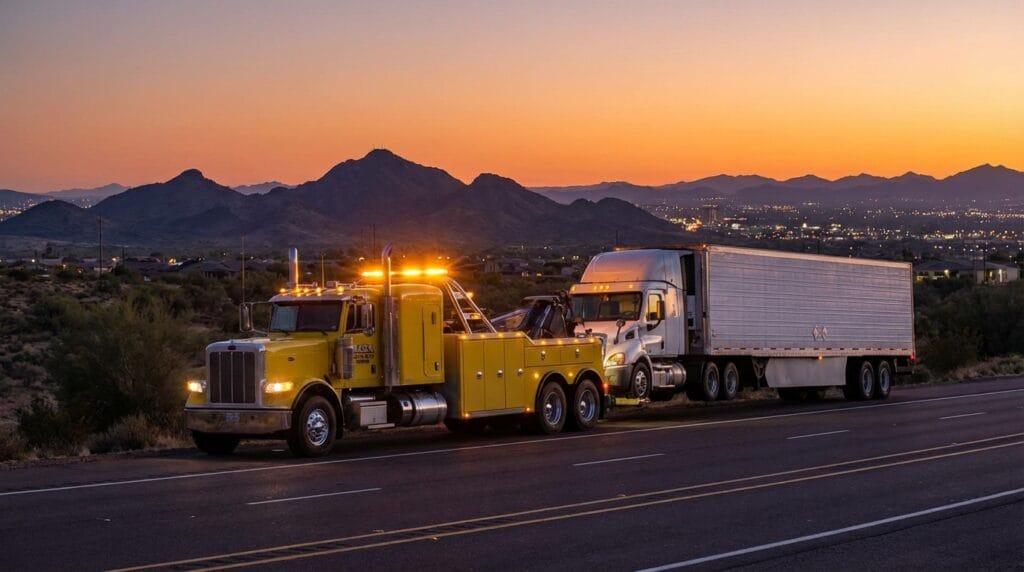
When your commercial truck or RV is stranded on the Loop 202, every minute of downtime costs you money and jeopardizes your schedule. Our specialized ***heavy duty towing*** service in Mesa is engineered to handle the biggest jobs, getting your valuable assets off the road and back in business with precision and speed.
Table of Contents
What Heavy Duty Towing in Mesa Really Means
Heavy duty towing isn’t just about a bigger truck; it’s a specialized discipline for vehicles exceeding 26,001 pounds Gross Vehicle Weight Rating (GVWR). In Mesa, this specifically refers to the recovery and transport of commercial vehicles that are the lifeblood of our local economy. This includes everything from Class 7 and 8 semi-trucks and tractor-trailers you see on the US-60 to city buses, dump trucks working on new construction sites, and large recreational vehicles (RVs) heading out of town.
Our service area encompasses the unique challenges of Maricopa County’s infrastructure. We handle incidents on major arteries like the I-10 and Loop 101, as well as complex recoveries in tighter urban spaces or remote desert roads. Unlike standard towing, which uses a simple hook and chain or wheel-lift, our heavy duty operations require integrated tow trucks, rotators with massive crane-like booms, and air cushion recovery systems for overturned vehicles.
The core difference is the equipment’s capacity and the operator’s expertise. A standard tow truck attempting to move a loaded semi would experience catastrophic failure, damaging both the casualty vehicle and the tow truck itself, creating a more dangerous and costly situation. We bring the right tools and certified expertise for the job, ensuring a safe, damage-free recovery every time.
The High Stakes of Commercial Breakdowns in Mesa
A disabled commercial vehicle is more than an inconvenience; it’s a significant financial event that ripples through a business. The costs extend far beyond the initial tow bill. We understand these pressures and focus on minimizing your total loss by providing rapid, efficient service.
- Lost Revenue: The most immediate impact is the halt in operations. A delivery truck isn’t making its drops, a construction vehicle isn’t moving earth, and a long-haul trucker is missing critical deadlines. This directly translates to lost income and potential contract penalties.
- Driver Costs: The driver’s Hours of Service (HOS) are still ticking away, even when the wheels aren’t turning. You’re paying wages for unproductive time, which can quickly add up, especially with federally regulated HOS limits restricting their ability to make up for lost time later.
- Reputational Damage: Late deliveries and broken schedules damage your reputation with clients. In a competitive market, reliability is paramount. A single major delay can lead a customer to seek out a competitor for future jobs.
- Secondary Risks: A vehicle stranded on the shoulder of a busy Mesa freeway is a safety hazard. It risks being struck by other vehicles, and cargo (especially perishable or hazardous materials) can be compromised. Swift removal by a professional vehicle towing service is critical.
The financial impact of downtime is staggering. While exact figures vary by operation, industry data provides a clear picture of the daily costs associated with an idle commercial asset. We’ve compiled estimates to illustrate the urgency.
| Vehicle Type | Estimated Daily Cost of Downtime | Primary Factors |
|---|---|---|
| Class 8 Tractor-Trailer | $800 – $1,500+ | Lost freight revenue, driver wages, potential late fees |
| Dump Truck / Construction Vehicle | $1,000 – $2,000+ | Project delays, idle operator costs, rental equipment fees |
| City Bus / Coach | $700 – $1,200 | Route disruption, passenger inconvenience, substitute vehicle costs |
| Large RV / Motorhome | $200 – $500 | Lost vacation time, alternative lodging, repair disruption |
Our Mesa Heavy Duty Towing & Recovery Process
Executing a successful heavy duty recovery requires a systematic approach grounded in safety, precision, and communication. Our process is refined from years of experience on Mesa’s roads. We don’t just show up and pull; we execute a strategic plan to protect your vehicle, our team, and the public.
- Detailed Dispatch & Assessment: When you call, our dispatcher gathers critical information. What is the vehicle type, weight, and cargo? What is the exact location and situation (e.g., rollover, mechanical failure, accident)? This allows us to dispatch the correct truck and equipment, whether it’s a heavy-duty wrecker or a rotator for a complex lift.
- Scene Safety & Security: Upon arrival, our first priority is securing the scene. Our certified operator will position the tow truck with optimal lighting, deploy traffic cones, and ensure the entire area is safe for recovery operations. This minimizes risk to other motorists, especially on high-speed roads. We coordinate with law enforcement when necessary.
- Strategic Rigging & Preparation: This is where expertise matters most. Our operator assesses the casualty vehicle’s condition to determine the best connection points. We use a variety of high-strength straps, chains, and forks to rig the vehicle in a way that distributes force evenly and prevents any frame or axle damage during the tow. For rollovers, this involves complex calculations to upright the vehicle without causing further damage.
- The Recovery Operation: Using the immense power of our specialized wreckers, we execute the recovery. This could be a straight pull, a complex lift with a rotating boom, or an air cushion recovery for an overturned trailer. Every action is deliberate and controlled, constantly monitored by our operator to ensure the vehicle’s integrity.
- Secure Transport: Once recovered, the vehicle is securely attached to our tow truck. We double-check all connections, disengage the driveline if necessary to protect the transmission, and connect air and light lines to ensure the towed vehicle is safe for transport on public roads, complying with all DOT regulations.
- Clear Communication & Delivery: Throughout the process, we maintain clear communication with you or your fleet manager. We confirm the destination—whether it’s your yard, a repair facility, or our secure storage lot—and provide an accurate estimated time of arrival. Our job isn’t done until your asset is delivered safely.
Not All Towing Is Equal: The Heavy Duty Difference
There’s a dangerous misconception that “a tow is a tow.” For commercial vehicles, this belief can lead to catastrophic damage, extended downtime, and serious safety risks. Using an under-equipped, light-duty tow service for a heavy vehicle is a recipe for disaster. We are frequently called to recover vehicles that were damaged further by improper towing attempts.
The fundamental difference lies in physics and engineering. Standard tow trucks are designed for passenger cars and light trucks. Their winches, cables, and frames cannot handle the immense weight and forces involved in moving a 40-ton vehicle. Attempting to do so can lead to a snapped cable, a bent frame on the casualty vehicle, or even the tow truck itself becoming dangerously unstable.
Our fleet is purpose-built. A heavy wrecker can have a boom capacity of 75 tons and winches rated for 50,000 pounds or more. This isn’t just about power; it’s about control. An expert operator uses this equipment to lift, not just drag, which is crucial for protecting the suspension, chassis, and drivetrain of your expensive equipment. Think of it as surgery versus brute force. You need a surgeon, and our team of experts provides that level of care.
As one of our lead recovery specialists often says, “You can’t tow a battleship with a fishing boat. We see it all the time—someone tries to save a few bucks with a smaller company, and we end up getting called to fix a much bigger, more expensive mess. Doing it right the first time is always the cheapest option.”
The Future of Heavy Duty Towing in the Valley: December 2025
The demand for professional heavy duty towing in Mesa and the greater Phoenix area is growing rapidly. As of late 2025, several trends are shaping the future of our industry, driven by the region’s explosive commercial and industrial growth. The Valley is a logistics hub, and the number of semi-trucks, delivery vehicles, and construction equipment on our roads is only increasing.
We are seeing a shift towards more sophisticated technology. The integration of advanced telematics is becoming standard. This allows for faster dispatch times, as we can pinpoint a vehicle’s location and often receive diagnostic trouble codes remotely before we even arrive. This helps us bring the right tools and parts, sometimes turning a tow into a roadside repair, which is a key part of our broader roadside assistance offerings.
Furthermore, recovery equipment is becoming more specialized. We are investing in even more advanced rotator booms that offer greater precision and lifting capacity, allowing for complex recoveries in tighter spaces with less traffic disruption. The industry is also moving towards more comprehensive training and certification programs to ensure operators can handle this new technology safely and effectively, a standard we have long upheld.
Sustainability is also emerging as a factor. Newer heavy-duty tow trucks are being built with more fuel-efficient engines and emissions-control systems. While the primary focus will always be on power and capability, we are conscious of our environmental footprint and are actively exploring ways to incorporate more efficient technologies into our fleet as they become proven and reliable.
Don’t Let a Breakdown Derail Your Business
A disabled heavy vehicle is a critical event that demands a serious, professional response. Every moment your asset is on the side of the road in Mesa, you are losing money and risking further complications. The solution is not just any tow truck; it’s a dedicated partner with the right equipment, certified expertise, and a deep understanding of the commercial vehicle industry.
We built our heavy duty towing service to be that partner. We understand the high stakes and are equipped to manage the most challenging recoveries, from simple tows to complex multi-vehicle accident scenes. Our process is designed for safety, efficiency, and the protection of your valuable assets. We are more than a towing company; we are a critical part of your risk management and business continuity plan.
Don’t wait for a bad situation to get worse. If you have a heavy truck, RV, or piece of equipment down in Mesa or the surrounding areas, make the right call. Contact our dispatch team immediately at 480-725-5862 or visit us online to request service and get your operation back on track.